

Chelsea should have beaten Tottenham Hotspur. With 64% of possession, and over 150 more passes completed than Spurs, Chelsea controlled the game. In attack, they were dangerous and caused Tottenham real issues. Likewise in defence, they were astute and dominant — able to stifle Spurs’ attacking-five with ease. How? A very smart transition…
Tuchel deployed one shape for attack and another as his team defended. The transition between the two has looked well-oiled so far. Even Lampard’s Everton and Conte’s Spurs haven’t been able to take real advantage of a system in its early development.
Since Tuchel’s arrival in London, Chelsea have been defined by a 3-4-2-1 shape, a specific iteration of the classic 3-4-3 in which the two wide forwards drop into midfield to create overloads in build-up.
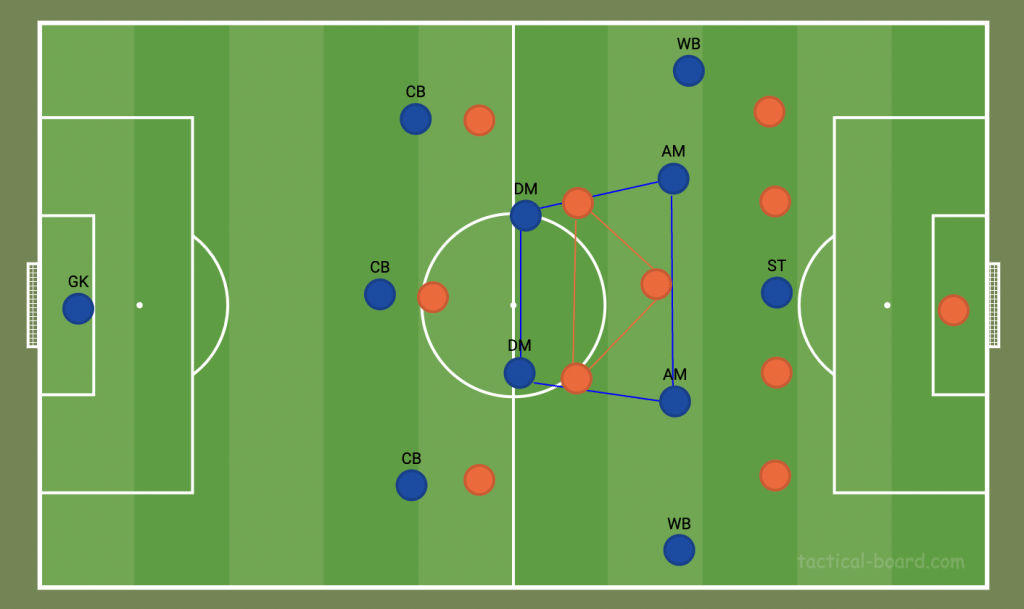
Due to the departures of centre-backs Andreas Christensen and Antonio Rüdiger, Chelsea’s ability to start three in defence is no longer. However, in the first two matches of the new Premier League season, we have seen alternative tactics used which still enable them to control games in midfield.
Tuchel has brought in Raheem Sterling, who will be a vital tool in Chelsea’s kit this year — as they change to a 4-3-3 (false-9) formation. Against Spurs, the front-three of Sterling, Mason Mount and Kai Havertz would swap regularly to pose threats in different areas, but one of them would always be between the lines to add an extra midfielder as they sought to progress up the field through the tight structure of Conte’s side.
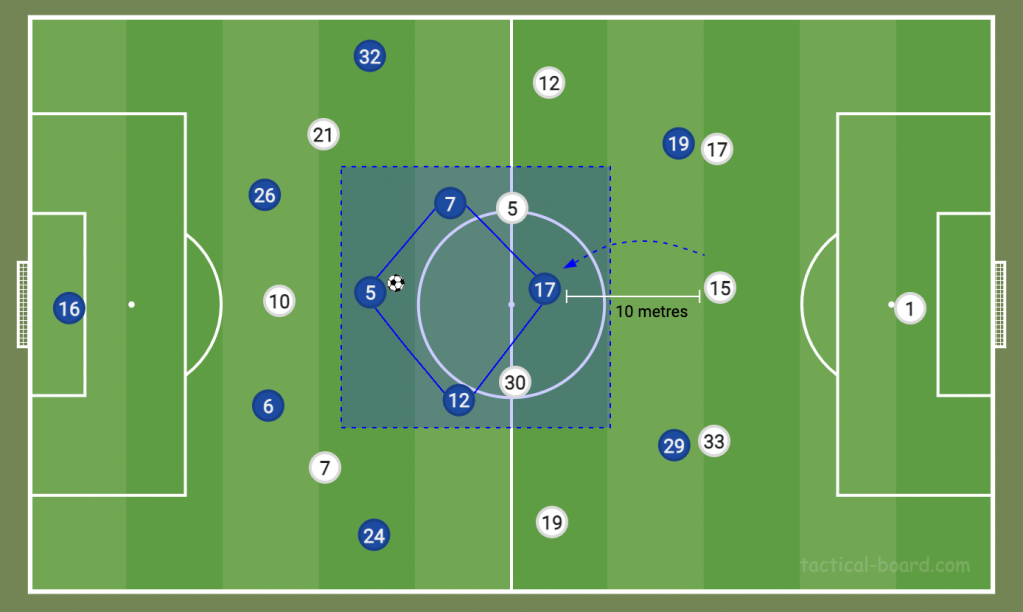
Eric Dier in particular faced a real issue here, as instinctively he would have wanted to follow Sterling into the midfield to foil Chelsea’s plan. However, vacating his position at centre-back would open up a far more direct route to goal for Chelsea. (There will be an entire article dedicated to defending a false-9 striker coming soon.)
Once Spurs had the ball, Tuchel’s plan was for his team to morph into a 5-4-1, as Chelsea have done for the last two years. However, while the most logical way to perform this transition would be for the defensive midfielder (in this case Jorginho) to seamlessly slot in between the two centre-backs behind him, a player like Jorginho has no experience in a back line, nor does he possess the aerial threat required for such a role.
Instead, Chelsea’s defensive transition this year will demand an awful lot from one player in particular: Ruben Loftus-Cheek.
To deal with Spurs, Loftus-Cheek shifted from right-centre-midfield to right-wing-back, with Reece James joining the centre-backs to form a three. In the 5-4-1, they matched Spurs up man-for-man, as seen below.
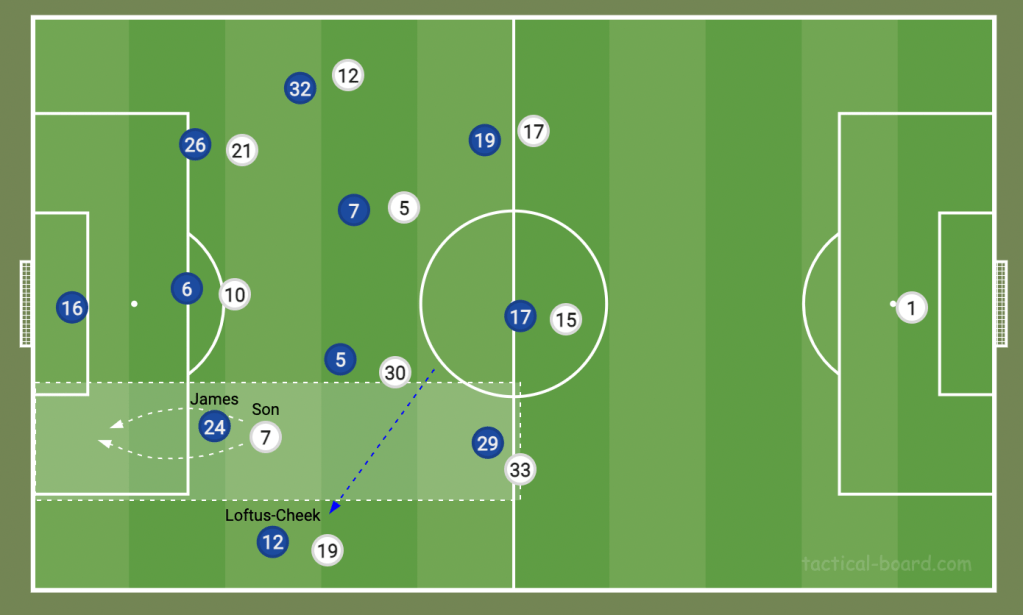
The main advantage of using Loftus-Cheek as the wing-back in defence was having a James vs Son Heung-Min battle in Chelsea’s right-half-space [see above]. James, with his strength and speed, was the best man to combat Son.
If Chelsea’s transitions from attack to defence, and vice versa, can be as sharp as they were against Tottenham, this strategy may prove to be very fruitful indeed.
 Tactically Speaking