
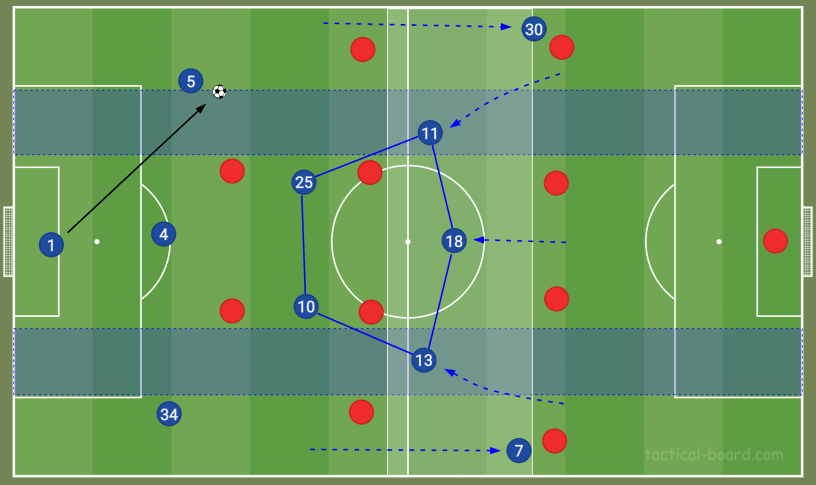
Every year, Brighton and Hove Albion are underestimated, despite a bank of evidence which suggests they are very good at winning the games they should win. Graham Potter’s main principles of play lie in demanding the majority of possession, making quick movements, and creating overloads.
It’s for this reason that most sides have opted to deploy a high and aggressive press against them — attempting to disrupt their rhythm.
However, Brighton’s ability to play out from the back and bypass a press is one of the finest in the Premier League. Robert Sánchez in goal is impressive with his feet, which adds an extra man to the first phase of build-up. On top of this, we have seen right-centre-back Joël Veltman stretch the play horizontally by pushing towards the touchline. This creates gaps in the middle if the opposition spreads to track Veltman, and triggers the movement of one of the central midfielders towards the play (often Alexis Mac Allister) as an option in the right-half-space.
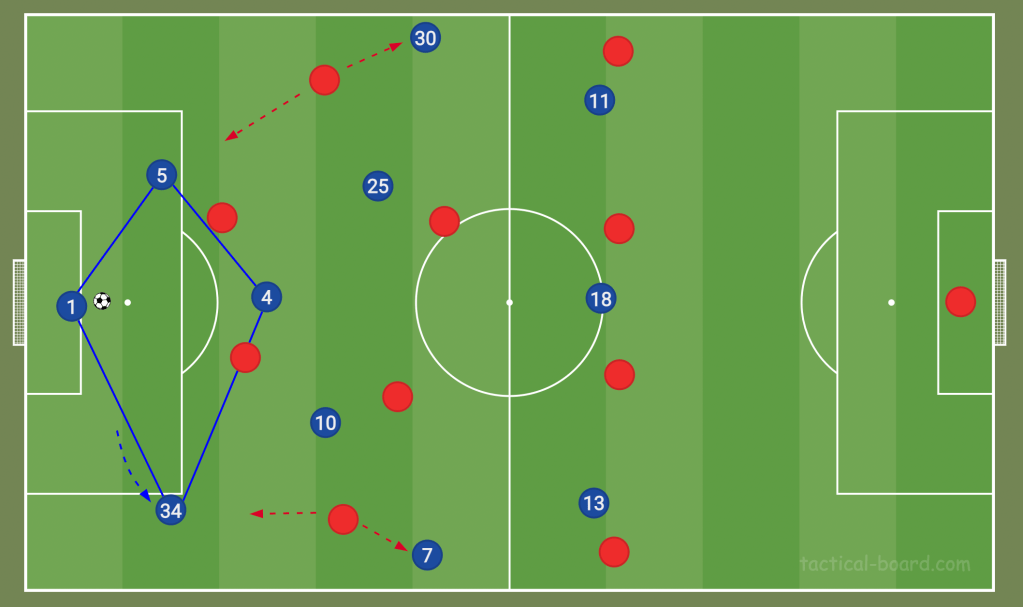
It is a recurring move which has frequently resulted in an overload, with five players committed to beating the high press. Manchester United and Leicester City in particular struggled to deal with these movements when they pressed aggressively.
Teams have had a tendency to remain compact, showing Brighton into wide avenues (blocking off central passing routes). This is a serious mistake against a side such a Brighton, who are most dangerous when they attack on the flank. The 3-4-3 shape offers three wide players on each side of the pitch, and the closest central midfielder for support infield as well.
Brighton have stuck with a 3-4-3 formation so far this season, but have adapted the way they use it due to the recent sale of their main striker Neal Maupay. In many ways, the alteration has helped them in their quest to dominate possession.
In short, their front-three have all become hybrid midfielders, with none of them playing as a striker. They join the midfield-two to make a five-man midfield, speeding up the second phase.
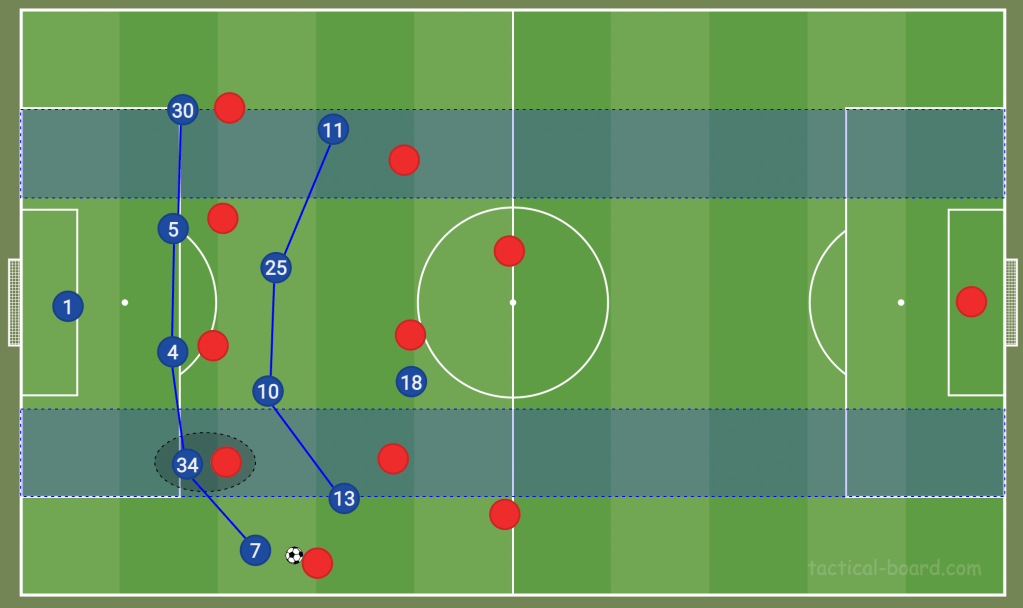
Brighton have to be selective in their use of this overload, however, so as not to allow the opposition’s back-line to track them and nullify the tactic. Here is how they do it:
During the first phase described above, the front three cover the width of the pitch and pin the opposing defence back deep in their own half. They do this to create a large gap between them and the midfield.

Once the press has been beaten and the defence have the ball, the three forward players dart into midfield. The important thing to note here is that Brighton’s wing-backs simultaneously push up onto the other team’s full-backs — keeping them pinned back, as seen below.

This suits the skillset of players such as Pascal Groß, who thrive in the half-spaces, receiving the ball on the angle. It also helps Brighton maintain width with the wing-backs, while increasing their control in the midfield.
This is very similar to the way Germany used a 3-4-3 at Euro 2020. Their 4-2 victory over Portugal emphasised the benefit of having forward players who could drop into midfield.
Finally, in a low-block, Brighton are able to defend half-spaces with far greater ease than other Premier League outfits as they don’t have to transition into a different formation. With three centre-backs, the half-spaces are naturally covered anyway, and this helps them defend man-for-man against opposition teams.
In front of the defensive line, there is an impressive transition which does take place. Potter has drilled his team in switching from a 5-4-1 to a 5-3-2 and back again, depending on where the ball is at any one time.
As displayed above, a four-man flat midfield helps them to cover the width of the pitch when other teams are attacking on the flank, but they can quickly change by dropping the striker into midfield and narrowing the wingers who then become the first line of pressure when the ball moves centrally. The front-two then provide a fast outlet for a counter-attack in the event of a turnover.
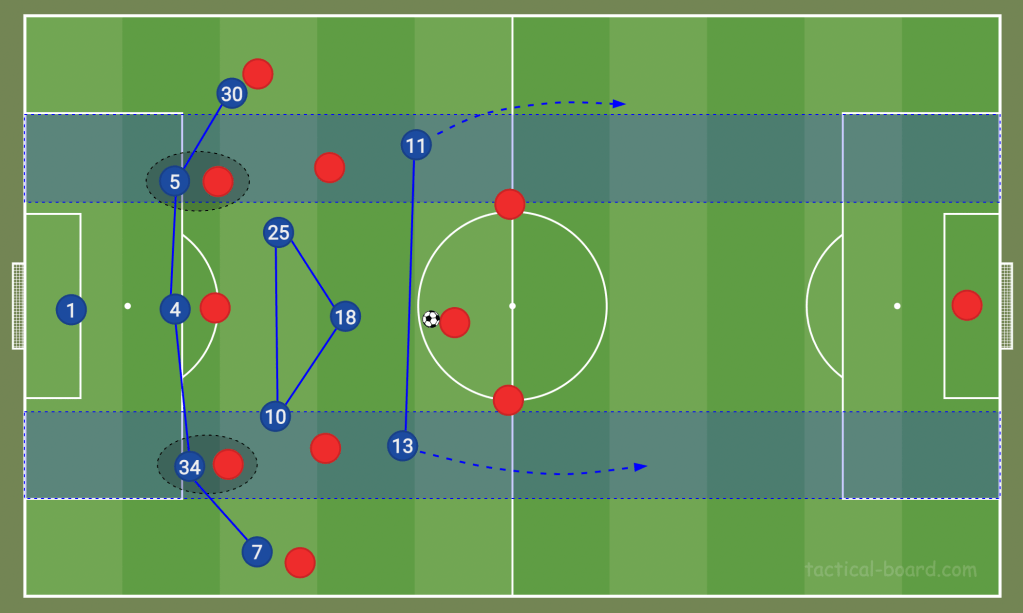
This is not a new tactic, but in fact one that Potter used during his time as a coach in Sweden. However, this is the first time since becoming the Brighton manager that he has been able to use it, since he no longer fields a No 9 and his attackers are more versatile.
 Tactically Speaking