
Erik ten Hag’s Manchester United are beginning the leap towards a new era in football whereby players perform individual functions rather than positional roles, and systems are all but dead.
Three players whose functions have proved particularly effective so far are new boys Christian Eriksen and Lisandro Martínez, and forward Marcus Rashford.
Christian Eriksen: The Overloader
On paper it has seemed so far as though Ten Hag views Eriksen as a defensive midfielder in a double pivot. However, this really doesn’t reflect his role fairly at all, once his team are in possession.
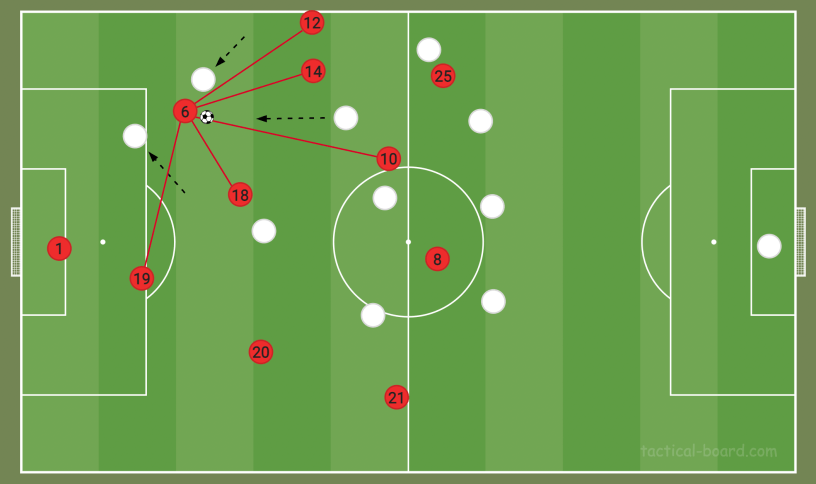
The Dane, like many in this new Manchester United team, doesn’t have a fixed position, but rather a duty to create overloads all over the pitch. In every phase of attacking play, and from right to left, Eriksen’s energies are spent ensuring that United have more players around the ball than their opponents — so that the ball carrier has enough passing options at any one time.

As seen above, the unorthodox rotation in midfield sees Casemiro push high while Eriksen drops in. He is then positioned perfectly to overload the opposition both in phase one (along with the centre-backs and goalkeeper) and phase two (with his fellow midfielders and full-backs once he turns to play out).
Last season, we scarcely saw runs off the ball from United players, and it was rather straightforward for opposition sides to mark players out of the game. The addition of Eriksen to the team is already helping to put that right.

Lisandro Martínez: The Press Absorber / Long-Ball Bait
The most obvious issue with United last year was their lack of mobility in defence. Harry Maguire is a competent ball-playing defender, but far from the fastest. The signing of Lisandro Martínez has given United mobility, and the former Ajax man is showing to be one of the best ball-playing centre-backs anywhere in the game.
While it may take decades longer for defenders to be solely functional, free of formational balance, with Martínez we are seeing early signs of defenders taking up duties as opposed to positions.
In the first phase, United are favouring the short pass now. Teams are already catching on by blocking passing lanes, but Martínez has such excellent dribbling and passing capabilities that he alone is managing to absorb a high and aggressive press. Teams are attempting to close him down as soon as he receives the ball. This frees up space for other players in midfield and across the back line who then become attractive passing options for Martínez.

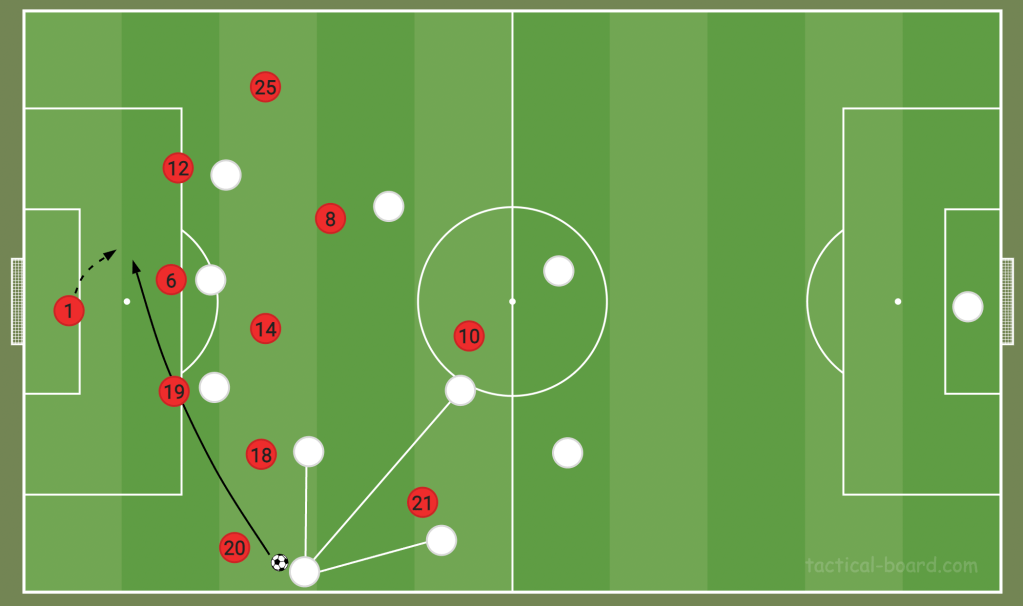
Against Real Sociedad, when he came on, Martínez was able to beat this press by himself at times, which immediately eliminated one or two opposition players from Sociedad’s defensive structure, as shown below.

The off-the-ball function Martínez is taking on, admittedly alongside left-back Tyrell Malacia, lies in creating traps and bait. Martínez and Malacia are 5ft7 and 5ft5 respectively, which is unheard of for defenders, so opposition sides have opted to play long balls and wide crosses towards their strikers in the knowledge that they can probably dominate aerially against Martínez and Malacia. However, the pair are usually quick enough to drop a few yards, preventing this from being an effective tactic, and United are comfortable defending crosses given the height and reach of goalkeeper David de Gea.
This is all part of disrupting the rhythm and game plan of opponents.
Marcus Rashford: The Decoy
Marcus Rashford’s game has always been centred around counter-attacking with pace. His function now, as a decoy striker, is to offer himself either in behind a defence, or by coming short towards the ball.
Not at all revolutionary, but this is something that United have been unable to do with Cristiano Ronaldo as the striker, given his undeniable target-man qualities. The purpose of Rashford’s function is to create space for Bruno Fernandes (either as a third-man runner or simply between the lines) and this was most evident against Liverpool and Southampton in the last few weeks.

The diagram above illustrates his movement when he came short in the first half against Liverpool, and the resulting hole which Fernandes was able to exploit with a third-man run. Manchester United hit the post, but this move worked wonders against Liverpool’s high line.
 Tactically Speaking