
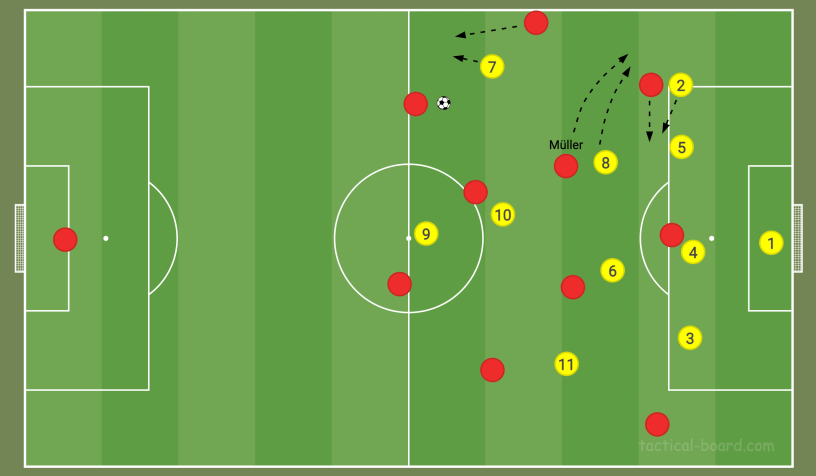
The term ‘raumdeuter’ has become a widely recognised role in football, but was originally used by Thomas Müller to describe the way he plays. Its literal translation is ‘space interpreter’ or ‘space investigator’. The idea being that some teams will have a player whose job it is to create overloads and manipulate opposing defenders by making third-man runs off the ball.
As Pep Guardiola has explained during his time at Bayern Munich and Manchester City, the aim of his team’s rotations is to move the opposition without having to move the ball a great deal. Guardiola was a big advocate for using Müller as a raumdeuter.

Müller is the kind of player whose best attribute is his brain and understanding of football — which is why he has perhaps been undervalued for most of his career. Much of what makes Müller such an impressive footballer is intangible. His goals and assists numbers are high year after year, but few have an appreciation for how he manages to be in the right place at the right time so often.
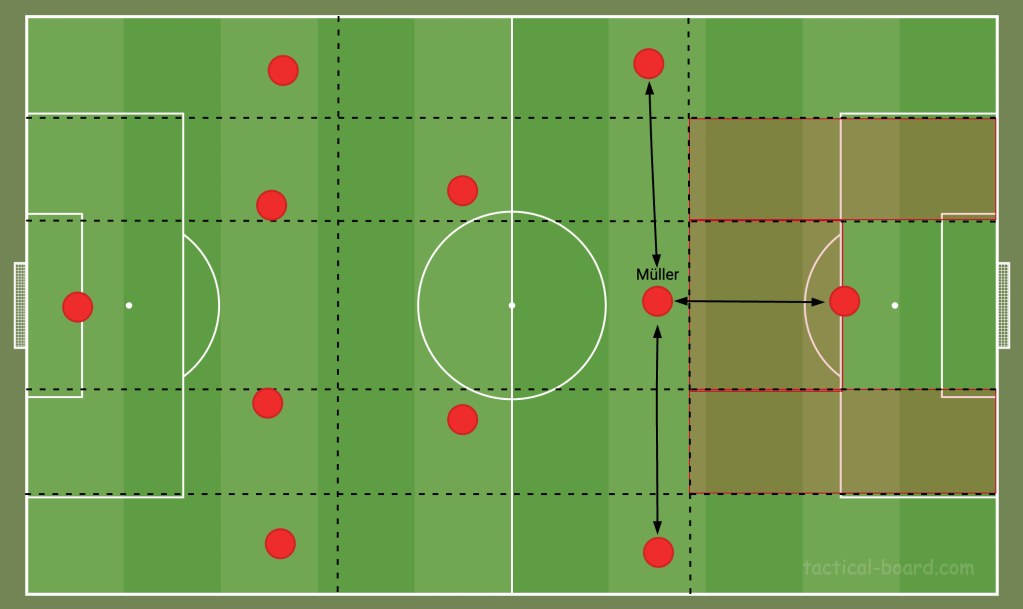
Müller, fluid and versatile, has been used in many positions throughout his career, including both left and right midfield, No 10, and centre-forward. His managers have preferred him in the No 10 position behind the striker, as from there he can roam free — drifting wide and forward at times too. Müller’s use of the half spaces and Zone 14 is important as these are areas which, when exploited, can be hard for defenders to control.
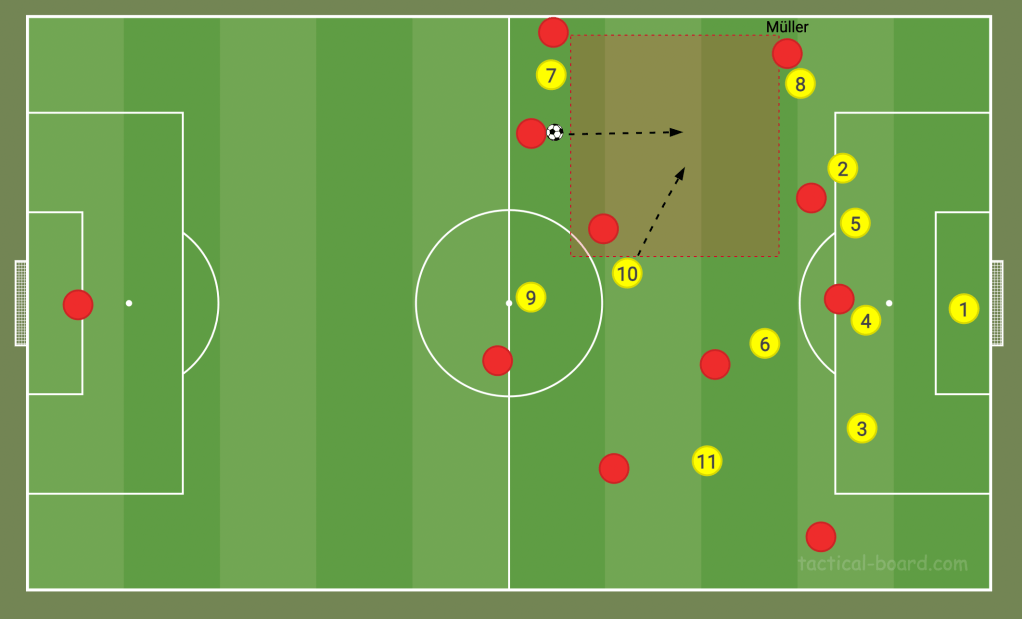
The diagrams below shows how a third-man run by Müller opens up a big hole in an otherwise quite congested area of the pitch for the winger to run into — with a view to getting into shooting range.


It’s important to appreciate that it takes a lot of understanding from teammates too, to know that Müller’s run was in fact a decoy run, and that he didn’t want his teammate to pass to him. Much of Müller’s work in the final third is done off the ball.
Other players have performed similar roles, resonant of the raumdeuter since Müller. Dele Alli at Tottenham Hotspur and Kai Havertz at Chelsea would be good examples of this. Arriving late and making off-the-ball movements — often undetected — are central to the way both play.
Oddly, the esoteric nature of Müller’s playing style will not go down as a great footballing tragedy. Rather, he has kept plugging away, generating the numbers behind the scenes. And there comes a point in every season when the footballing world begins to re-marvel in the longevity of his dominance and the insanity of his numbers, in just the same way it did 12 months prior.
 Tactically Speaking