
The first thing to say about FC Union Berlin is that they are not sitting first in the Bundesliga through a display of aggressive, open, high-pressing football domination. This has never happened with an outsider team sustainably. Instead, six of their 15 goals so far this season have come from counter-attacks or long balls forward, and four have been from set pieces already.
Union Berlin have got a very distinct game plan, built on humility and respect for the fact that their opponents may be better sides on paper, and that they may not see the majority of the ball in every game.
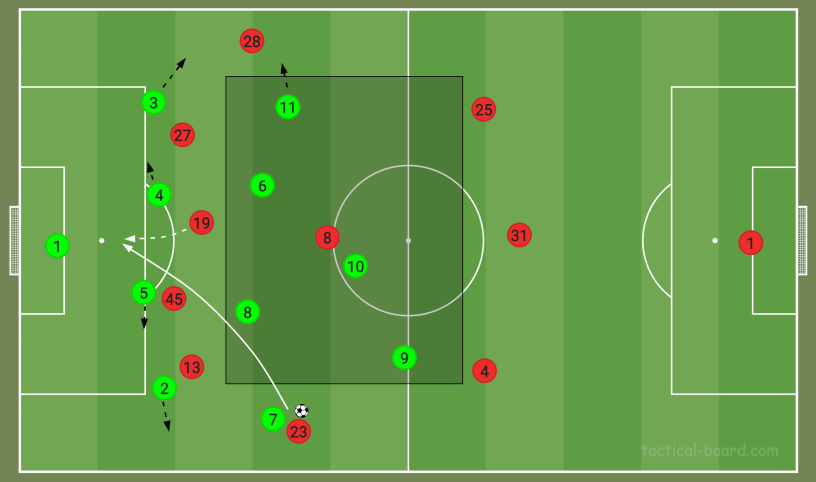
With the knowledge that most of their opponents will want to control possession against them, Union have developed an approach based on counter-attacking — incorporating many of their strengths. The idea is to almost entirely vacate the central zone in build-up, leaving just Rani Khedira (their composed holding midfielder) in the middle.
Attacking down the flanks, the centre-backs can offer great width, along with both wing-backs. Their other two attacking midfielders (usually No 19 Janik Haberer and No 13 András Schafer) push up onto their opposition back-four, joining the two strikers. This pins the opposition defence back with a four-v-four, leaving ample room for the wing-backs to provide quality in their delivery.

The reason they do this is to stretch the opposition in midfield. With the central zone vacated, opposing teams have begun to do the same, as it isn’t worth their players standing in the middle. They are of course better off stretching wide to where Union are most dangerous.
However, Union are well drilled to expect this reaction, and in fact use it as a trigger to play a quick long ball through the middle of the pitch — very much in keeping with their direct, counter-attacking philosophy. Indeed they have become a team who don’t want the ball very much, because when they do win back possession, they can pounce quickly before the opposition have transitioned.
For this reason, they have had to be well-drilled defensively. To start with, they press in their regular 3-5-2 formation. When two strikers are deployed for an initial press, the team on the ball almost always play to their full-backs. The image below shows how defending in a 3-5-2 shape does leave opposing full-backs with acres of running space.

Again, using this as a trigger, they then transition into a 5-4-1, with Theoson Siebatcheu or Kevin Behrens dropping back as a wide midfielder, leaving Sheraldo Becker (the top scorer in the Bundesliga with six goals in seven games) as a lone striker.
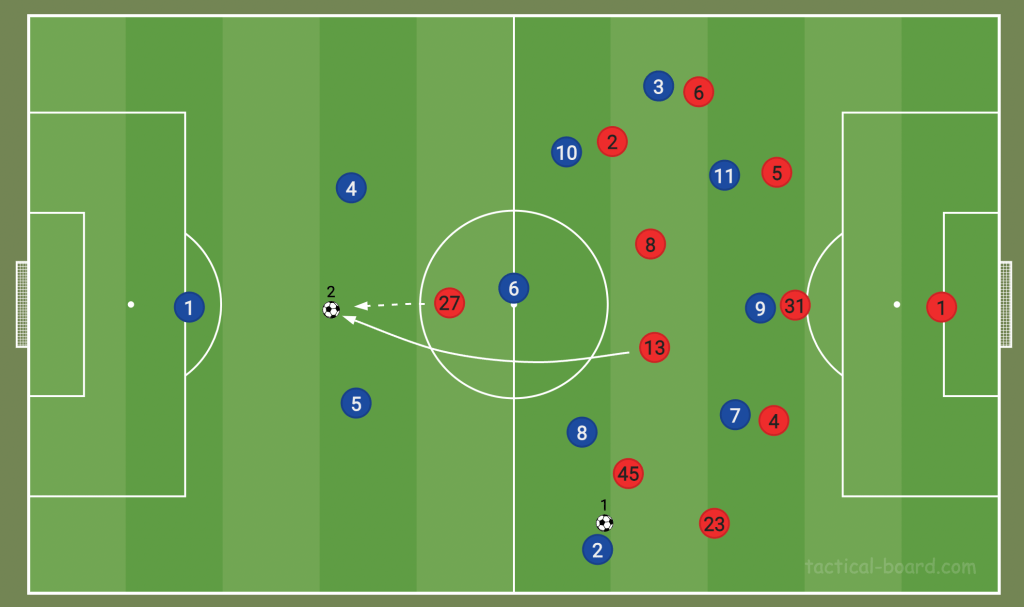
Union tend to soak up lots of pressure in this shape, allowing their opponents very little space. Once they win the ball, they tend to play a long ball forward or launch a counter-attack, as shown above. This was most evident in their 6-1 thrashing of Schalke 04.
Set pieces have been a huge factor in Union’s success so far this season. Due to the speed and agility of their attackers such as Sheraldo Becker, other sides have opted to defend corners in a sort of hybrid between zonal and man-marking — in which four players cover the six-yard box while the other four man-mark.
The issue here however, is that this leaves Union with a five-v-four overload on the edge of the box. The league leaders have also adopted various strategies for attacking set pieces, including crossovers and faint movements. The diagram below shows how crossovers and faint movements can confuse man-markers, meaning Union’s main target-men can shrug their markers off and get free without having to enter the six-yard box.

Union Berlin will undoubtedly drop a lot of points this season, but their game plan is difficult to combat. They are accomplished at setting passing traps for their opponents, and are one of Europe’s most dangerous sides on the counter-attack right now. They may find it hard as the season wears on, however, to continue to surrender possession and play counter-attacking football — as other clubs will want to do the same against them.
 Tactically Speaking