

This year, Julian Nagelsmann’s Bayern Munich side are centred around their midfield duo more than ever before. Joshua Kimmich and Leon Goretzka have formed quite a partnership together, and the team relies on the coordination of both in order to carry out its dangerous game plan.
On numerous occasions, Nagelsmann has confirmed that he sees the No 6 position as the most important in his footballing philosophy. This is because during his stints as manager at Hoffenheim and RB Leipzig, his sides always revolved around this No 6 player — the pivot.
Bayern have a few ways of involving their No 6 Kimmich early in the first phase. They can set up with a 4-2-3-1, 4-3-3, or even deploy a back-three with almost a 3-1-4-2 shape. The latter is named loosely, but in theory is the best way for Nagelsmann to stretch his team as wide as possible. The idea behind this is to overload wide areas, attracting their opponents wide too, with a view to completely vacating the central zone. This leaves Kimmich with as much time and space as possible, which has been a desire of Nagelsmann since his arrival as manager in Munich.

The three defenders in this shape (made up of the two orthodox centre-backs and right-back Benjamin Pavard) maximise the passing routes into Kimmich. This is also where Leon Goretzka’s impact can be seen. Goretzka is usually found rather high up the pitch in the first phase, almost level with Thomas Müller, which forces both of the opposition’s central midfielders back into a deep position. This is another way of allowing Kimmich as much space as possible.
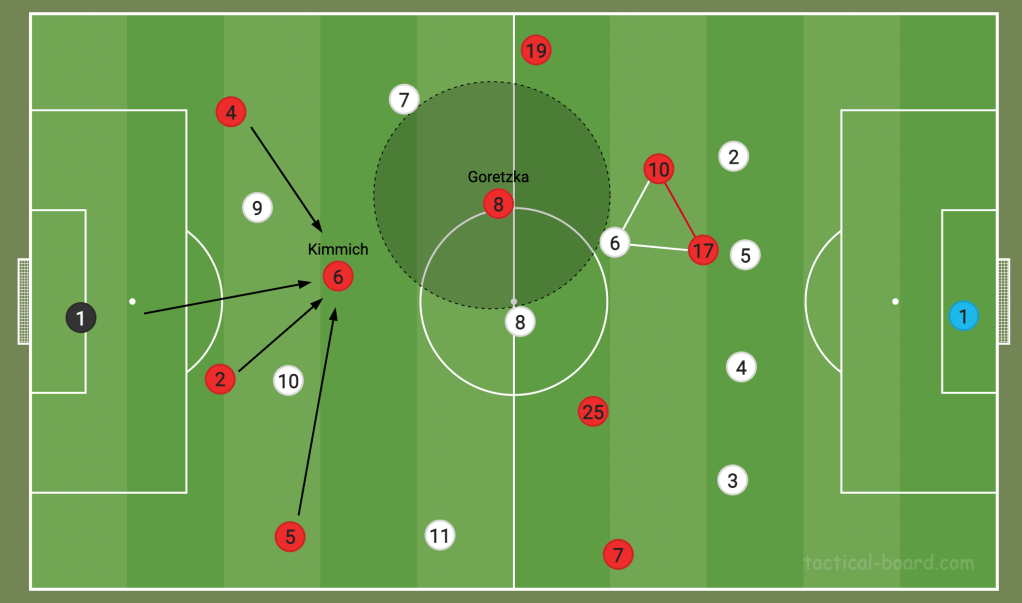
Once Kimmich is on the ball, he is able to make a long or short pass to anyone on the pitch, but can also beat a player on the dribble with his nimble stature and fast acceleration. With Bayern keeping at least two players on each flank, stretching the opposition, Kimmich is often able to find Goretzka in the left-half-space. Goretzka, like Kimmich, is very good at receiving a pass with his back to goal and turning quickly to play forward.

If this can all be performed at speed, remembering that so far Bayern have played just two passes to get from the goalkeeper to beyond the second line of pressure, then the opposition’s front-four should be completely out of the game — still behind the ball. Goretzka, here, tends to play another pass quickly, either out wide or to one of Bayern’s front-three. However, the absence of Kimmich ahead of him leaves a big hole in the right half-space. Sometimes Müller drops into this pocket to receive the ball, but Goretzka can also drive into this area to help switch the play to the right-wing safely.
By finding a way to play just three passes to get within shooting range, Nagelsmann’s Bayern are being as direct as possible without risking possession with long-ball football.
However, there are of course moments when a more composed and structured approach is required in attack. In the final phase, the back-three has been maintained so far this season. Kimmich and Goretzka create a double pivot, left-back Alphonso Davies and right-winger Serge Gnabry provide the width and stand on the last line — even further forward than Bayern’s front-three, who position themselves between the lines and are fluid in their interchanging of positions with each other.
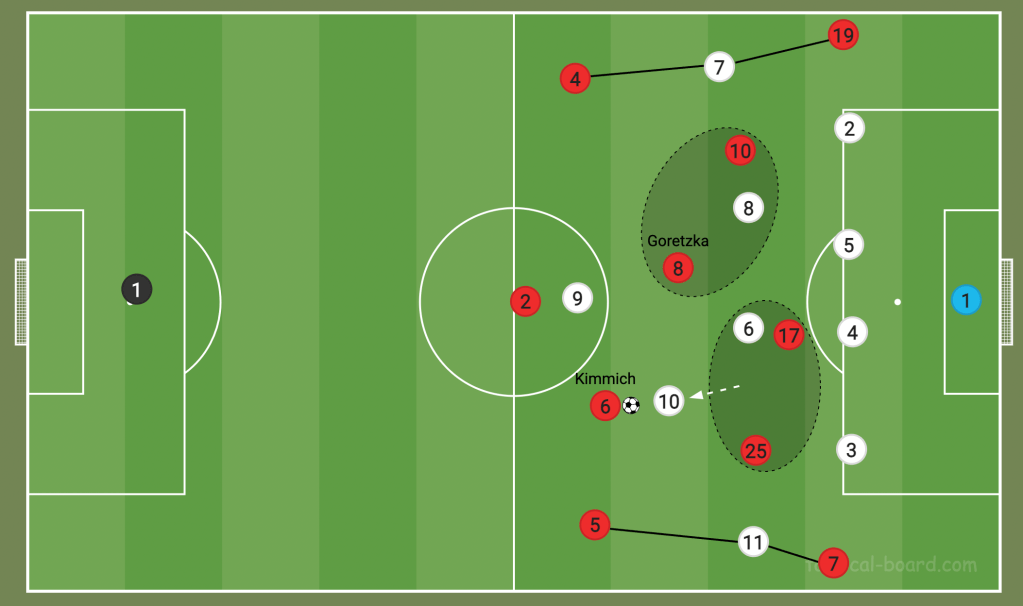
This is a largely similar setup to that of Germany’s Euro 2020 side and Thomas Tuchel’s Chelsea, and is favoured by many of the world’s top German coaches for its direct attacking possibilities.
When either Kimmich or Goretzka has the ball in this phase, they draw the press of one midfielder, leaving the other two to deal with four Bayern players, as seen above.
 Tactically Speaking