

Jude Bellingham was misbranded when he burst onto the scene at 16 for Birmingham. The now 19-year-old has developed into a very specific type of player, and it’s not what the football world expected.
Bellingham was described as a ‘foraging 8’ by England manager Gareth Southgate in March this year, when shutting down calls that he could be England’s deep-lying midfielder for years to come. It’s a label which sums the Borussia Dortmund man up rather cutely. Here are three of the qualities making Bellingham very unlikely to ever evolve into a holding midfielder:
Froward carrying:
The attribute we have learned to associate most with Bellingham is dribbling. Last season, he made the most forward dribbles of any Dortmund player, with over 50 percent of them successful. A lot of this is down to his body disguise and close control. In fact, no one was fouled as often as he was in the Bundesliga.
He now makes so many dribbles per 90 minutes that Dortmund have had to bring in an extra defensive midfielder to be able to back him up from a deeper position. If possession were to ever turn over and Bellingham were playing in a holding role, Dortmund would be in trouble.

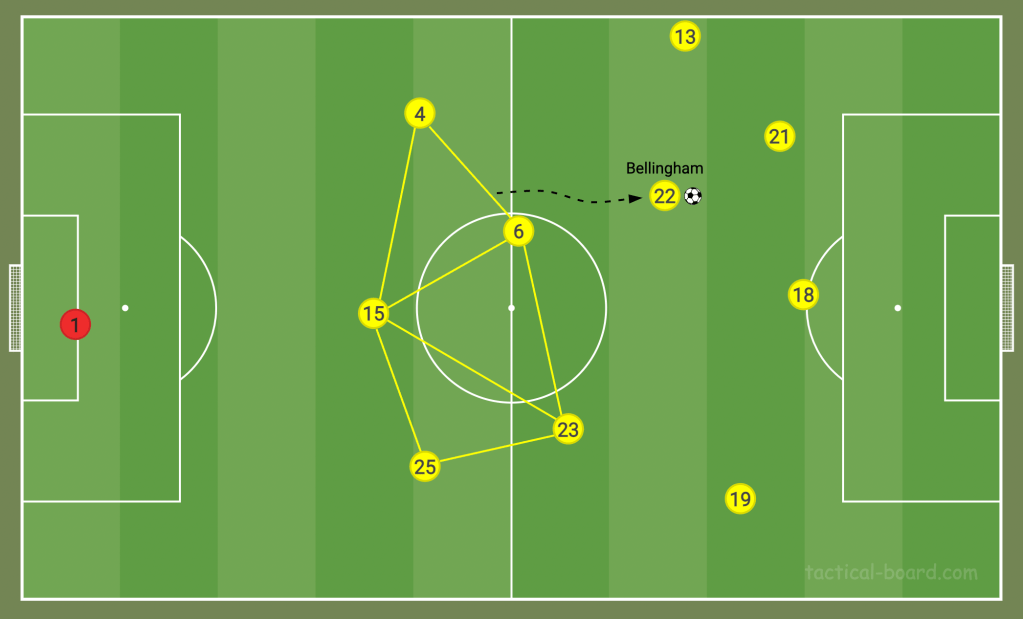
Often Bellingham is the orchestrator of attacks for Dortmund and England, and this means he is rarely in a position to protect the back line when his team loses the ball.
Wriggling from tight spaces:
The ability to face up against multiple opposition players at once, and still come away with the ball is not one many players have, but Bellingham is particularly adept in these positions.
While it’s beneficial for every player on the pitch to have this kind of quality, Bellingham would be wasted in a No 6 role, given he is so consistently successful in tight spaces. Were Bellingham receiving the ball off the goalkeeper or back line, he would be in a lot of space, but without the option to play into a fellow midfielder for progression. Dortmund build up through central zones usually, and, as seen below, having Bellingham as a No 8 (where the congestion of players is more obvious) gives their holding midfielder another passing option.
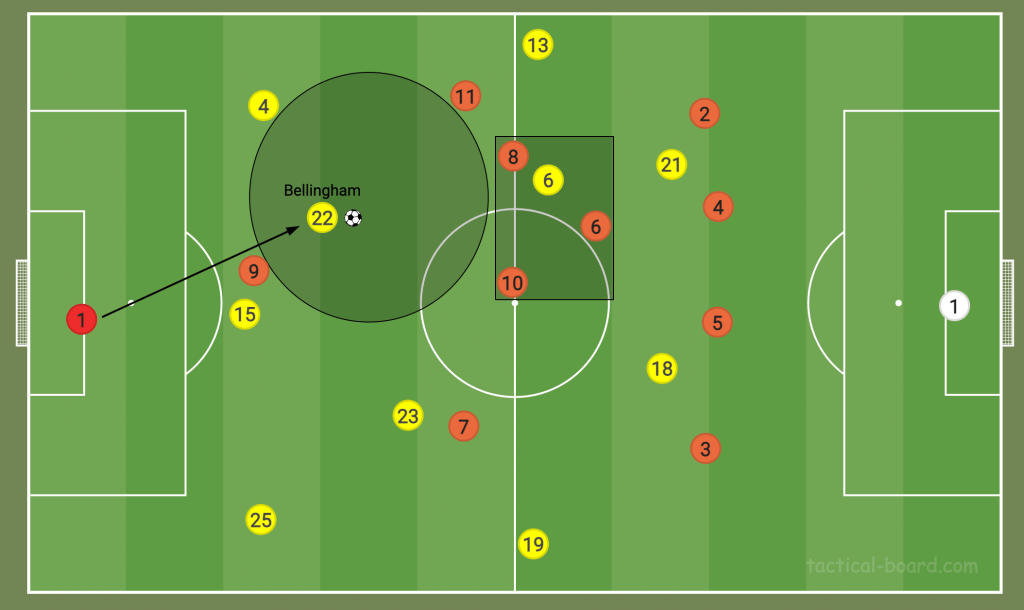
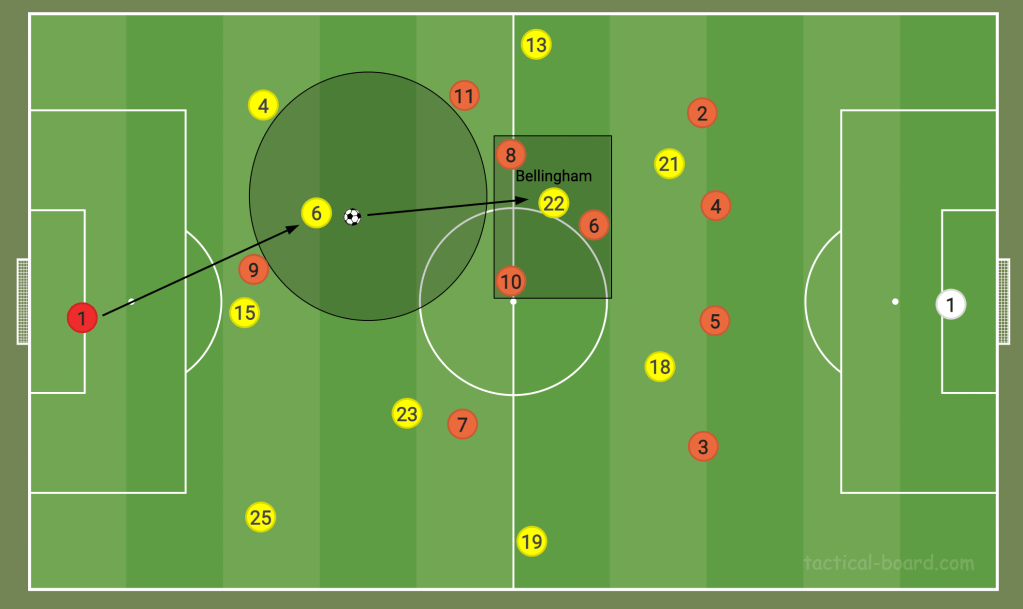
Aggressive tackling and chasing:
The difference between pressing and chasing was explained by Jürgen Klopp. Pressing is the application of pressure to an opponent with a view to forcing the play into undesirable or dangerous areas. To chase is to apply pressure with a view to making a tackle/interception to win the ball back aggressively.
There is a time and a place for each, but a defensive midfielder should rarely chase the player on the ball unless they are guaranteed to win it. Bellingham is a keen chaser, and when deciding between making a tackle or pressing he will usually make the tackle. This is fine, and has helped Dortmund and England make swift turnovers over the last two years. However, as is seen so often in young and zestful midfielders, Bellingham has a tendency to be over-ambitious and naive in deciding when to chase or make a tackle. Sometimes, the better option for the team would be for Bellingham to apply pressure, in a more structured and composed way.
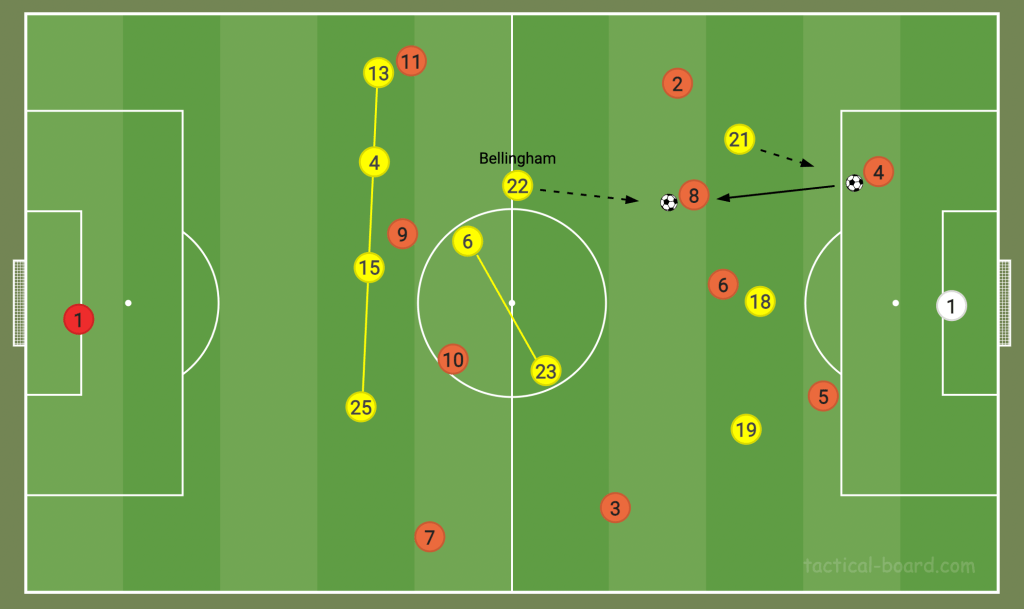
It’s likely that this will come with time, and Bellingham will become more mature in his defensive decision-making. However, both his club and national team coaches have been able to use this trait to their advantage. Deploying Bellingham as an offensive No 8 in a 4-3-3, they have both afforded the 19-year-old greater licence to chase. For example, Gareth Southgate often sets his team up to defend with a 4-4-2 in the high block. Within this setup, Bellingham is regularly instructed to push up and join the striker with the initial chase. Here, his occasional naivety is less exposed, and his impressive ability to create turnovers in possession can be utilised.

 Tactically Speaking