

The first thing to say is that this USA side is very athletic. With the second youngest squad at the competition, they use their zip and zest to their advantage. With fast players all over the pitch, they are able to defend with a high line, and press more aggressively than other nations.
England knew this would be the case. There would be few options for the player on the ball at any given moment. It made playing fluid, attractive, uninterrupted football would be near enough impossible. The USA relished the opportunity to break up England attacks, disrupting the rhythm. On the ball, they like to attack at speed and it meant the best way for England to defend would be to sit just a little deeper than they usually do — affording no space to their opponents.
Many would mistake this for a boring and frankly bad England performance. It was in fact the only way England could expect to approach the game if they wanted their first clean sheet of the tournament.
Ultimately, however, they couldn’t score at the other end. The USA defended as well as was expected.
They changed to a 4-4-2 when England had the ball at the back. This is different to their opening game, but they did it to stop England getting the ball into their technically gifted midfielders. The aim was to show England wide.
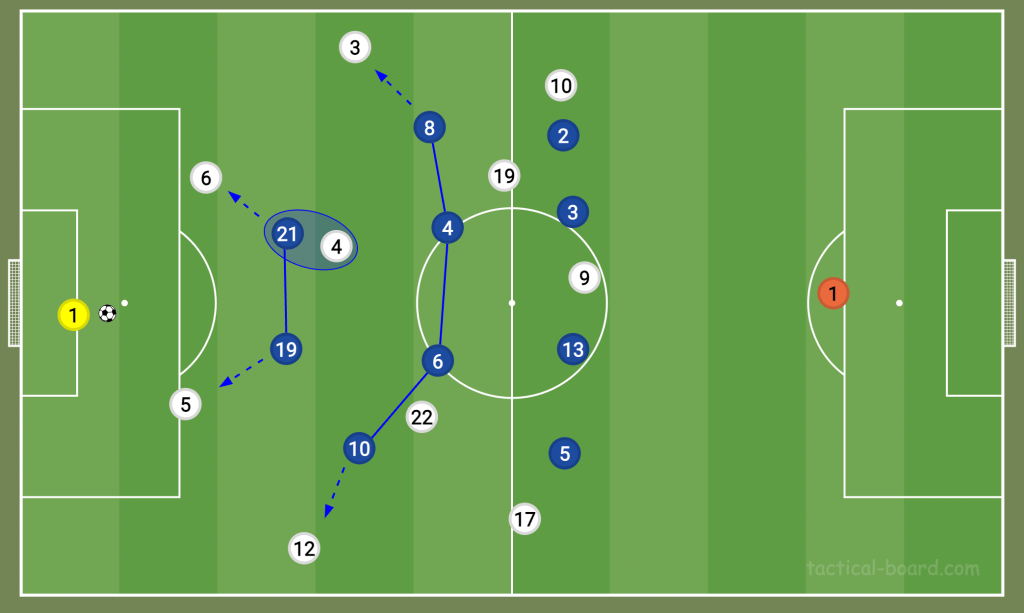
As seen above, Declan Rice tends to join the centre-backs in build-up, and he’s often the spare man. The USA’s front-two could press England’s centre-backs, but to avoid Rice receiving the ball, one would often block the passing option to him, while the other pressed the player on the ball.
England were forced to play into their full-backs a lot. At this point, Gregg Berhalter’s team would revert to their more familiar 4-3-3 shape, as this helped them go man-for-man in wide areas. Christian Pulisic, their star winger, would join a front-three, from midfield, and press the full-back. This would create a staggering effect in the USA’s defensive shape, allowing central midfielder Yunus Musah to track wider to mark Jude Bellingham.

The change of shape from 4-4-2 to 4-3-3 also meant there was less physical demand on the strikers to shuffle across the width of the pitch — which is near enough impossible to do quickly when there are just two. They would instead be used to block the pass back to England’s centre-backs.
England have previously come unstuck against teams with an aggressive pressing tactic. The Netherlands, Czech Republic, and Scotland have all prevented England from creating chances respectively over the last three years. Mistakes played crucial roles in those games too. The fact that England were able to stay composed and retain possession for large periods last night is a big milestone in their journey under Gareth Southgate — though the scoreline may not suggest it.
 Tactically Speaking