

Conor Gallagher is not the sort of midfielder who ends up going under the radar. Everyone knows at least one midfielder who, despite being an excellent footballer, doesn’t get talked about all too much and, in actual fact, is easily dispensable from their team. It’s usually because they aren’t offering anything that isn’t already there. Conor Gallagher is just the opposite.
Gallagher has broken through just as the No10 profile is going out of fashion. A No10 himself, he, like many, has had to adapt. These days, the work typically performed by the No10 gets passed onto forwards in attack and midfielders in defence. During an attack, strikers will drop in to play as a false-9 — taking up similar areas to those that the No10 used to, and off the ball, we often see one midfielder push up to help with an initial press. Gallagher has adapted, and he’s a rare commodity in the modern game.
What’s he known for, then? Well, his defensive work rate is quite remarkable. Not only that, but he’s very good at what he does too. Gallagher’s an energetic midfielder who’s constantly chasing down opponents. Relative to other No10s who have had to tweak their game to fit into modern systems, Gallagher has slotted very comfortably into a No8 role. It’s been seamless. This is mainly down to him, but he’s also benefiting from the tactics on trend right now — especially the gegenpress.
Gegenpressing is a German method for pressing off the ball, which Jürgen Klopp is widely credited with bringing to England. It involves committing between three and seven players to a high and aggressive press, forcing mistakes from opposition players on the ball. Gallagher has relished the opportunity to defend by pressing high up the pitch in areas he’s used to, despite playing in a midfield-three.
This season, most teams in the top five leagues in Europe have performed something similar to a gegenpress at one time or another. It’s why Newcastle are so high in the league, and Napoli are one of Europe’s best teams.
The important thing to note here is that while Gallagher is playing in pressing teams, his real skill lies in chasing, not pressing. This might seem like semantics, but pressing is done to force a bad pass by the opposition player. Chasing is done with the sole intention of winning the ball with a tackle. Gallagher chases.
Historically, chasing down opponents haphazardly has been easy to bypass: slip the ball to a teammate before the chaser gets to you. However, with teams pressing high now, a chase is always backed up by the press just behind. A team bypassing a one-person chase will still face an organised press. Suddenly chasing opponents seems much less risky and is something many sides, such as Liverpool, have been very good at.
Gallagher is effective at this because his work rate and exceptional agility mean he can change direction and track movement anywhere, making it hard for attacking teams to escape his presence.
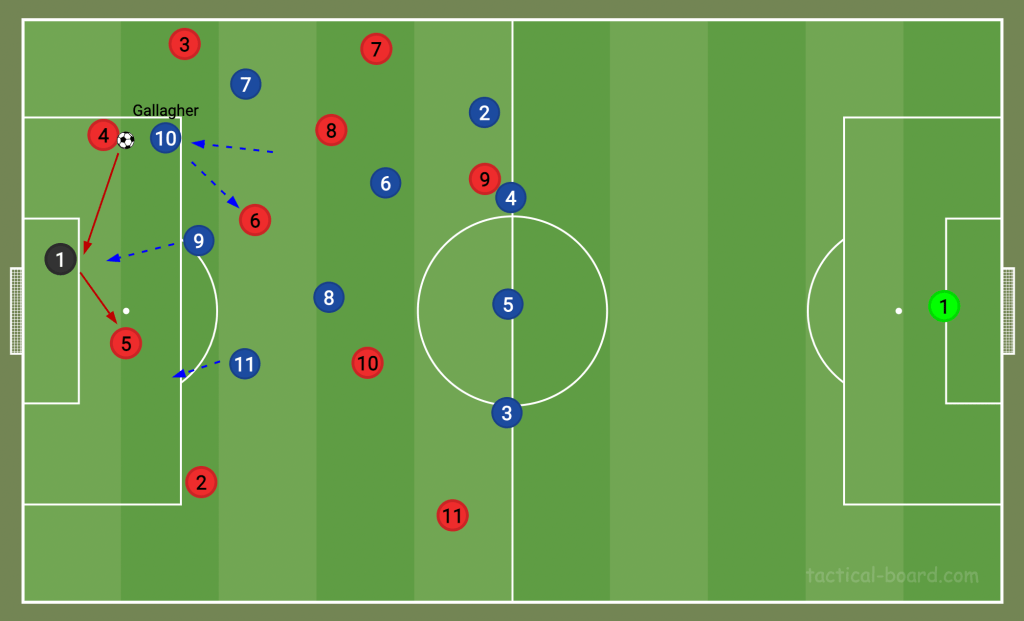
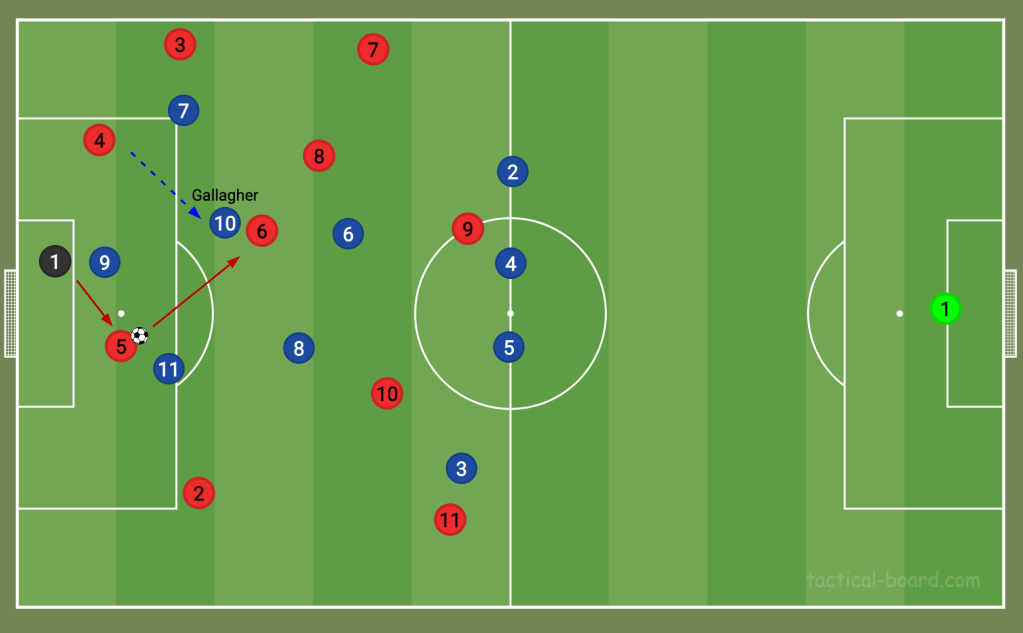
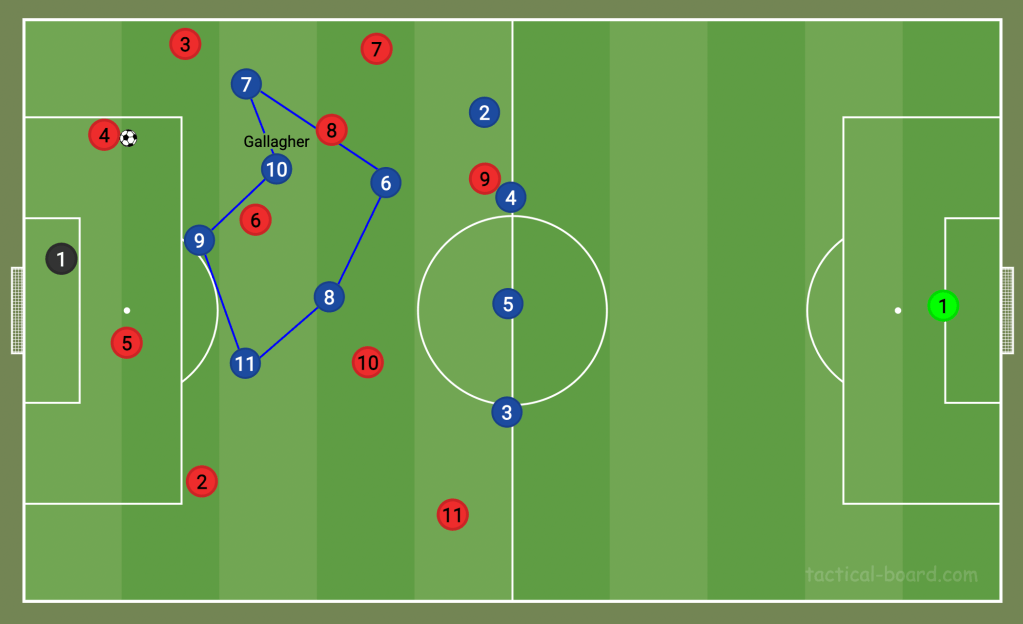
The image above shows a typical chase from Gallagher. He’ll go after the player on the ball, and once they pass sideways, he’ll know to recover back to the spare attacker (in this case, the No6) so that they cannot then receive the next pass. He does this all at impressive speed.
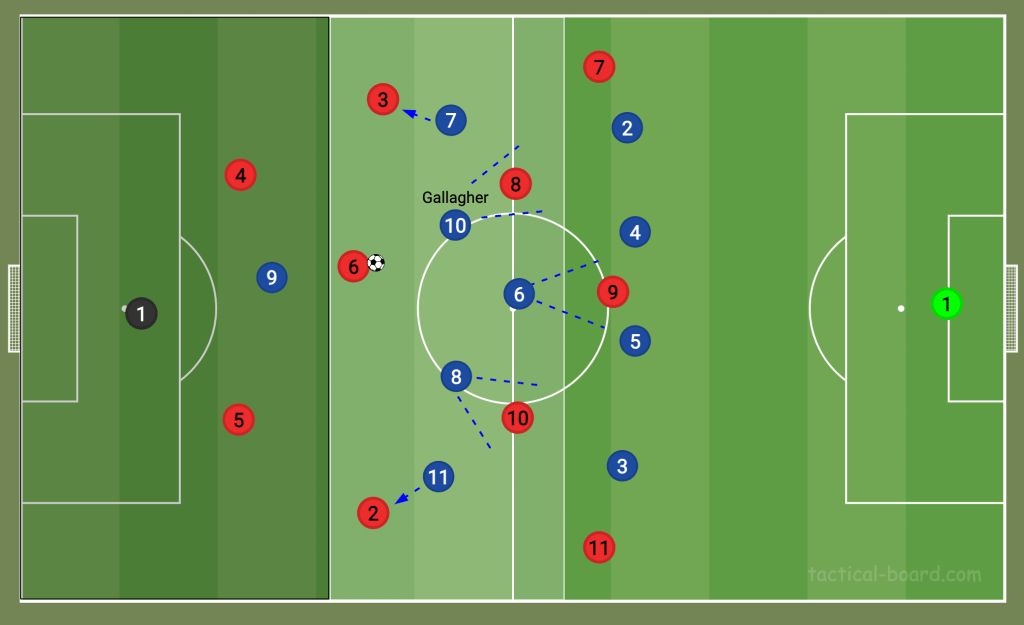
Many teams that defend in a 4-4-2 shape during the initial press and then proceed to fall back into a 4-5-1 formation in the mid-block could use a player like Gallagher. We saw this when he was at Crystal Palace last year. He can join the lone striker for the initial press, but he has the engine to retreat quickly to block a forward pass in the mid-block.

In this image below, the players in the black box on the left are behind the ball and rendered ‘out of the game’ for this phase of play. If Gallagher didn’t drop back, there would be a five-v-four overload for the red team in the white box. This is why he has to get back, and he has been proficient at this both in a Palace and Chelsea shirt.
 Tactically Speaking