
Why should we care about Enzo Fernández? Well, he’s just become the record-breaking signing for Chelsea, costing over £100m. Why were Chelsea prepared to pay this kind of money? That’s to do with a couple of things Graham Potter’s side have struggled with this season. Here’s why Chelsea have signed Fernández.
Half-turns in for progression:
Fernández is a nimble player. He’s neither strong nor tall, but his low centre of gravity enhances his ability to make quicker movements than most players. He’s similar in this way to Marcos Senna, the old defensive midfielder, a pivotal member of the Spain team that won Euro 2008.
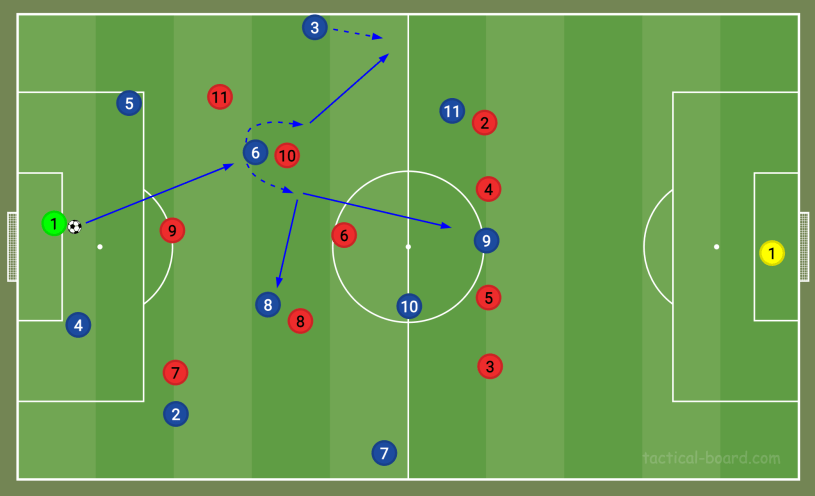
His old club Benfica used him in a clever way. His role in build-up meant that he was able to start the progression phase as well, getting them up the pitch and starting attacks. He would receive the ball off the goalkeeper and take the ball on his back foot, turning round the corner — away from his marker’s shadow. From there, he would always find a forward pass.

That might not sound like anything out of the ordinary, but Chelsea don’t have a player who can do this. The defensive midfielders already on the club’s books are bigger, less elegant ball carriers. Chelsea have faced serious problems against high-pressing teams. Manchester City did it, Newcastle did it, Liverpool did it. They pressed man-to-man, and Chelsea’s midfielders had to play the ball first time back to another defender or play a 90-degree pass out to the full-back. The problem is that this pass will always go to the full-back’s wrong foot because playing a through-ball is not possible from this angle. That leaves them on the back foot straight away. The signing of Fernández should help Chelsea in these scenarios.

Excellent reading of play:
Chelsea have different formations they deploy depending on the phase of play they’re in. It helps them achieve Potter’s attacking principles, but it can leave them vulnerable if the opposition counter-attacks. Their defensive transitions demand more of some players than others, like the right-winger, who has to become a wing-back when the ball is lost. In those situations when Chelsea are out of shape, Fernández will be a big help.
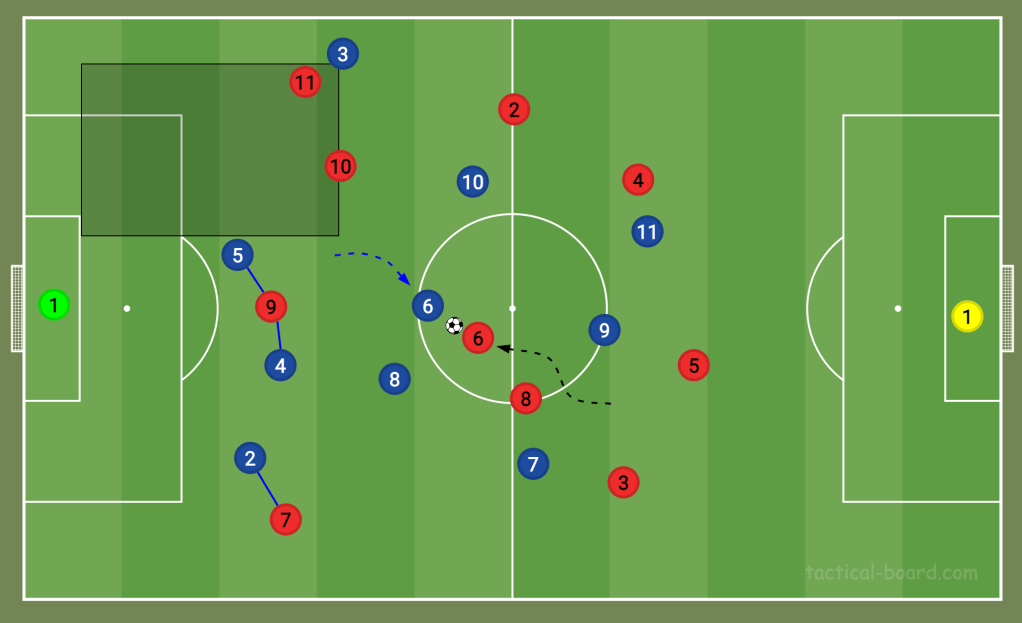
He is exceptional at reading the game and always staying one move ahead. The diagram below shows a typical counter-attack when Chelsea are running back to defend. There is a large gap in the left-back area. It’s simple for the opposition to play into the space and shoot with the No11.

However, Fernández will know that the two centre-backs can take care of the No9 and that the right-back is tracking the No7. So blocking the obvious pass to the No10 won’t leave Chelsea exposed. He won’t just run towards the No10 to intercept the pass, though. He’s very good at curving his run when he blocks a pass. This way, he can both block the pass and press the ball carrier at the same time. If he gets close enough, he can make a tackle.
Mezzala support:
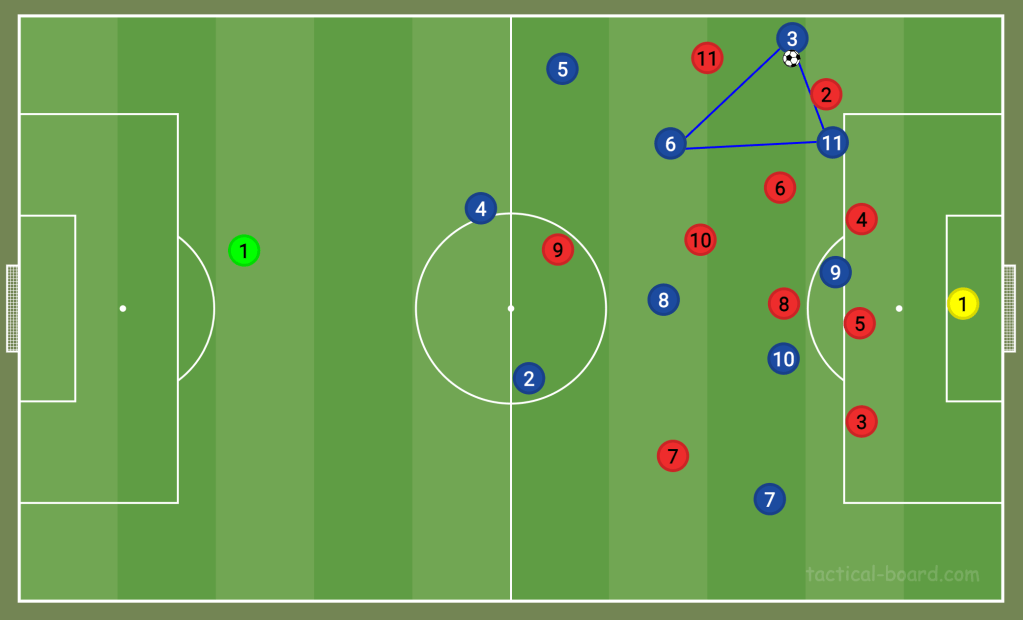
It wouldn’t be correct to label Fernández a true CM. He’s usually the deepest midfielder. However, he isn’t averse to joining in with attacking triangles (often on the left side) as a mezzala would. A mezzala is one of the two outside midfielders in a central midfield trio. The word is derived from the Italian for ‘midfielder’. Kevin de Bruyne and Jordan Henderson are classic examples of mezzalas. Fernández did this a lot at Benfica, joining in wide triangles when the opportunity arose. It’s never been a chief instruction of his game, but it’s something he has shown to be good at on a sporadic basis. In this respect, he’s similar to Arsenal’s old midfielder Tomáš Rosický. Rosický was a CM who liked to drift wide and occasionally even overlapped the wingers.
So Fernández is a player who can solve many of the problems Chelsea are facing in numerous phases. A cross between Senna and Rosický, he’ll work nicely in Chelsea’s system. A double-pivot when they appear in a 3-4-3, a mezzala when there’s cover behind him and a very keen ball-winner. Chelsea already have deep-lying playmakers, and this guy will be the perfect supplement.
 Tactically Speaking