
Manchester United and Newcastle have been two of Europe’s very best teams since the World Cup, and they’re about to meet in the Carabao Cup final. Man United have a tactical mastermind at the wheel whose innovations are a constant talking point. Newcastle have the fitness and aggression to be able to play the boldest football; they’re a team of high risk and high reward now. So, how will they impose their game plans on each other, and what will the responses be?
Newcastle’s gegenpress:
Newcastle are now one of the fittest teams in the Premier League, and this shows in their running figures per game. It allows them to play really high-pressing football when the other team has the ball.

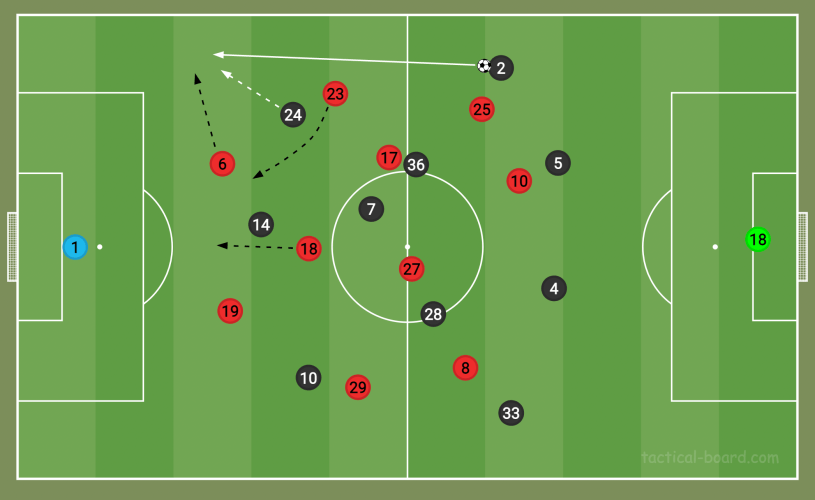
We see a lot of teams who set up in a 4-3-3 morph into a 4-4-2 to press, but Newcastle don’t. They want to force the opposition one way, and then totally block them into a corner. The press can take a man-to-man form if needed, but the idea is for each of the front-three to be backed up by each of the midfield-three.
When they do this right, it blocks every short pass the attacking team can make (either with cover shadows or by tight south-side marking), forcing them into playing long balls.
The trade-off is that they always leave a large gap between their midfield and defence, but that’s usually a worthwhile gamble since it requires an opposition centre-back to pump the ball up accurately to a teammate, which will rarely work.
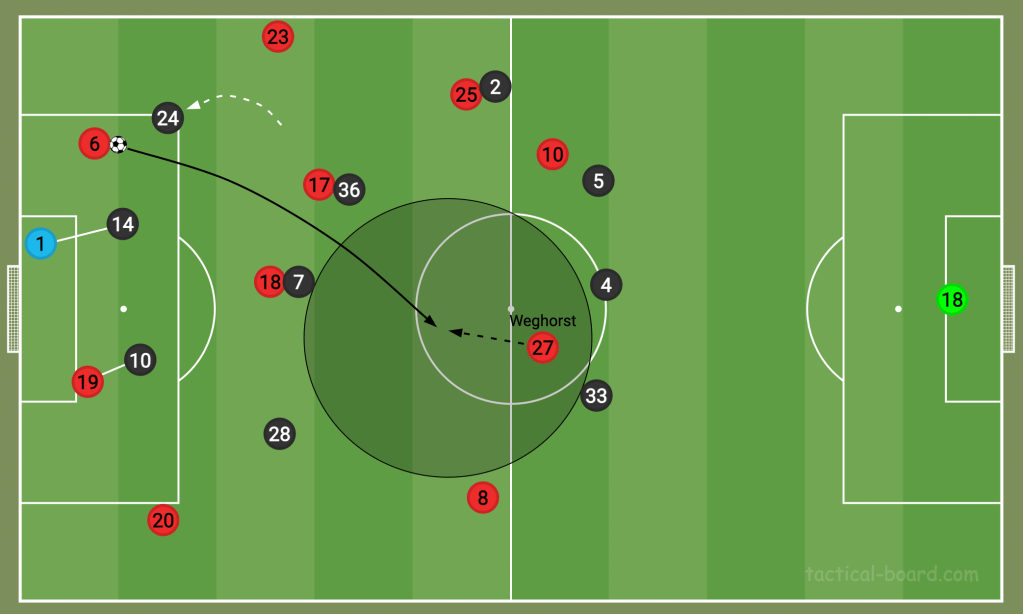
For this reason, Erik ten Hag might favour starting Wout Weghorst over an extra winger, so that he can be a target man in this hole, to receive a long ball and flick it on to a teammate. Man United could also exploit quick switches of play to bypass Newcastle’s gegenpress.
Man United’s left-side overload:
In their current way of playing, including typical personnel, Man United can create substantial overloads on their left flank. Despite playing as a striker, Rashford’s starting position is regularly in the deep left-wing, and Fred likes to wander out to this side as well.

Therefore, during the progression and circulation phase, Newcastle will have to be even more compact laterally than usual by shuffling over to each flank as a unit. That’s the only feasible way they’ll be able to stop Man United from enjoying these wide numerical overloads.

Again, if Newcastle do this, it means they will have to be aware of the potential quick switch over to the right-wing that Man United could play, so turning side on to the play (facing Man United’s goal) will be important for Dan Burn, Newcastle’s left-back.
Newcastle’s channel through-balls:
All season, Eddie Howe’s men have used a through-ball out wide, from full-back to winger, when they win possession and want to initiate a fast transition. This ball capitalises on the space behind the opposition’s 2-3 rest defence shape (two centre-backs and three in front of them, usually comprising two full-backs and a defensive midfielder).

Ten Hag might decide to change his rest defence from a 2-3 to a 3-2, with both centre-backs and a right-back — probably Aaron Wan-Bissaka instead of Diogo Dalot — behind two defensive midfielders. This would place Lisandro Martínez much closer to the path of this through-ball, and he could cut it out before the winger reached it, or at least engage the winger in a one-v-one duel.

If not, Man United could keep their shape the same, get Martínez to cover and Luke Shaw to track back centrally, with Casemiro filling in at centre-back.

These are just a few things for each team to consider ahead of the final on Sunday, but there is of course far more to talk about. Leave a comment or drop a message with your thoughts and any conundrums you feel could help decide the outcome.
 Tactically Speaking