
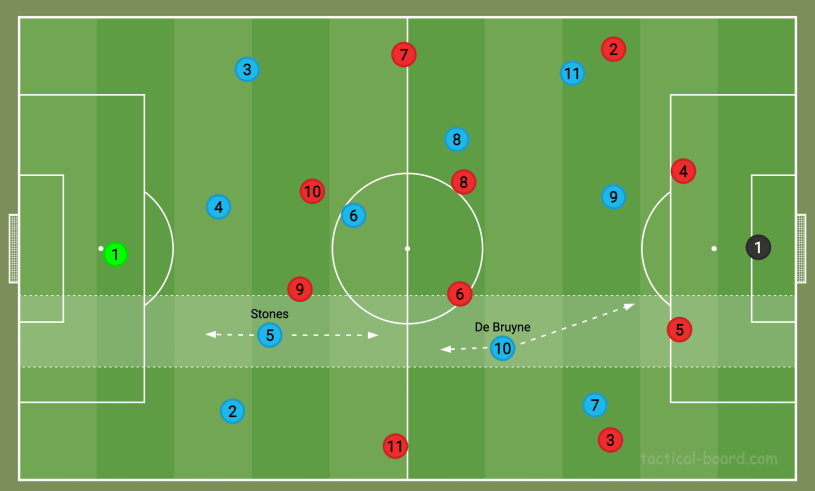
John Stones’s shift into a double-pivot has been a big talking point, and there are a few reasons for this.
Firstly, Pep Guardiola’s attempts to use an inverted full-back, or even have Bernardo Silva drop to left-back off the ball, caused two significant issues. The distances these players would have to travel in transitions were too far, and this took its toll on energy levels and positional harmony. Also, whether it was Rico Lewis, Bernardo Silva or Kyle Walker, these players played large proportions of games in particularly unfamiliar positions.
John Stones has played in midfield before, which has helped him with things like receiving passes with his back to goal — arguably the biggest difference between playing in defence and in midfield. The likes of Lewis and Walker found it difficult to adapt to receiving the ball this way, but Stones has adjusted seamlessly.

Man City’s 3-box-3 shape has one important advantage in build-up: the lack of bridge between the wide centre-backs and the wingers means opposing sides often neglect the flanks and scrunch centrally, leaving an easy pass to feet available out wide, bypassing a press. As the season has passed, teams have tried to compensate for this, reverting to pressing with wingers, as seen below. However, by contrast, this leaves City with a large central overload, where Stones’ inclusion in midfield has helped Kevin de Bruyne.
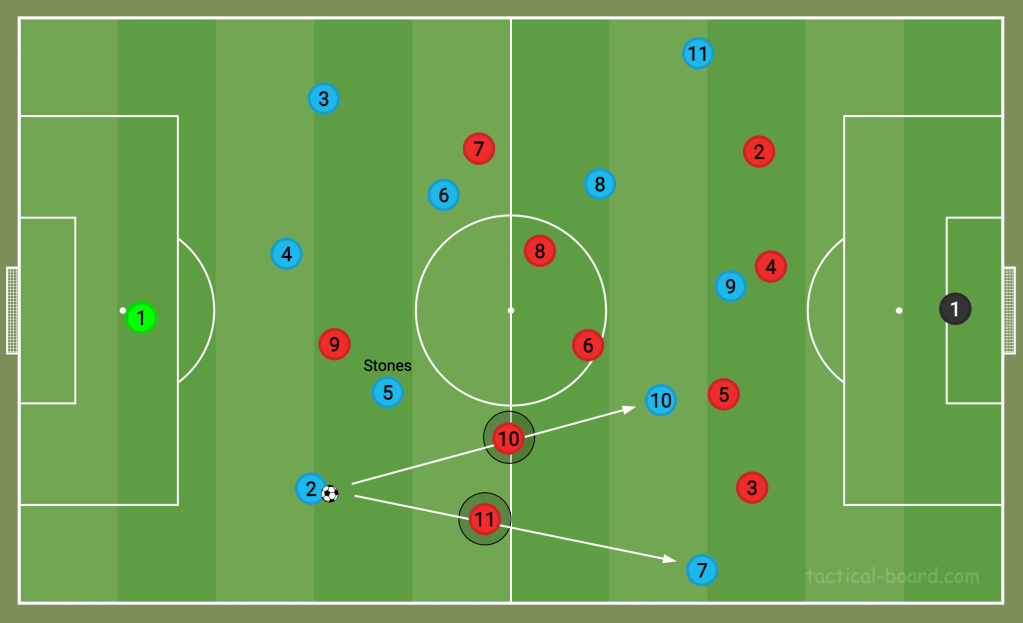
Stones is proficient at playing penetrative vertical passes instead of angled passes inside or out. For this reason, he’s been labelled ‘risky’ throughout his career, but it’s very definitely more of a strength than a weakness. De Bruyne likes to receive these passes, too, since his role this year has meant he finds himself between the lines in possession a lot of the time.
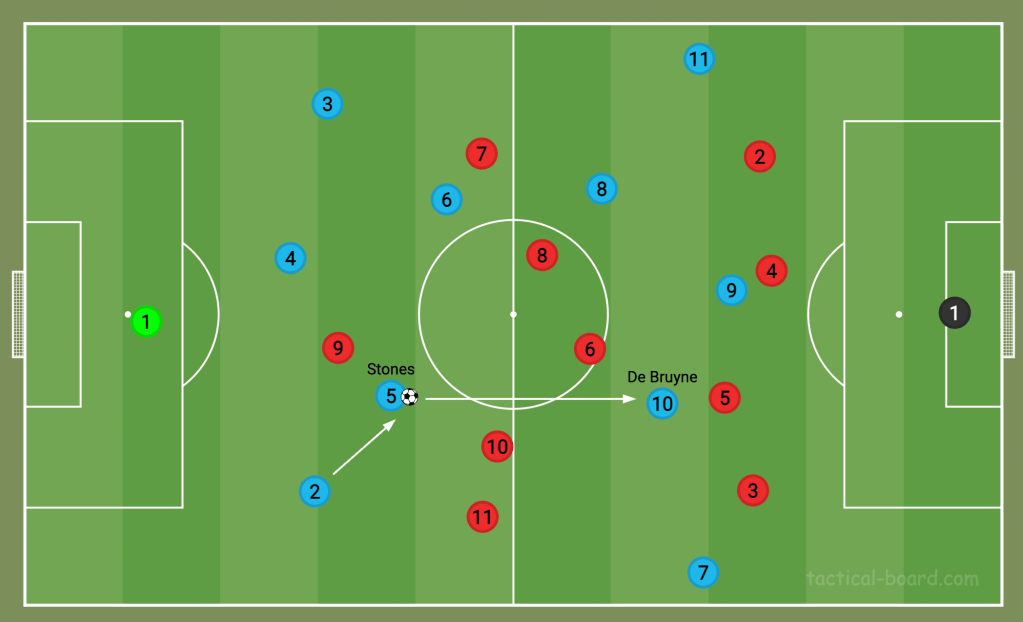
This pass from Stones to De Bruyne has helped speed up City’s attacks and is made possible by the fact that opposing sides have to use multiple players to cover wide areas when playing Guardiola’s team.
Similarly, when pressing, De Bruyne has recently been instructed to join Erling Haaland to form a front-two, meaning the right side of midfield is left vacant. Stones’ presence at right-centre-back means he can track De Bruyne’s run along that vertical half-space in a way that Lewis or Bernardo Silva could not (due to their positions off the ball).
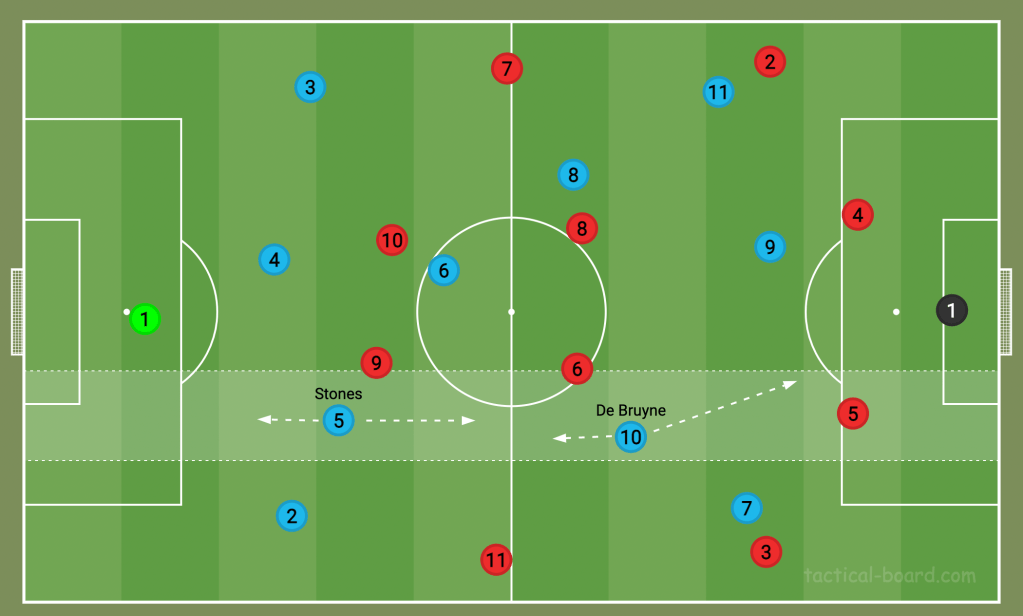
Not only has Stones been playing well, but the new tactic which sees him advance into midfield is also easier to follow, quicker to execute and positionally more familiar than any other iteration of 3-box-3 Guardiola has trialled this season.
 Tactically Speaking