

Borussia Dortmund find themselves at the top of the Bundesliga table with five league games left, largely thanks to their nine-game winning streak from January to March. How did they manage to turn their average season around? Well, a subtle change in midfield helped a lot.
All season, Edin Terzić’s side have built up with a 3+1 structure consisting of both centre-backs, left-back Raphaël Guerreiro, and deep-lying playmaker Salih Özcan. The decision to remove their midfield destroyer Emre Can from build-up and replace him with Özcan meant Dortmund could play through a press with more quality in the passing. Jude Bellingham has played most of this season as the most advanced midfielder of the three, causing positional problems between the lines.

Until recently, Dortmund would have a natural overload on the right side, and they looked to exploit this every time they could. This is where they would preferably progress the ball, luring the opposition in before playing a quick switch to the left side, where direct winger Karim Adeyemi would be left one-v-one with a full-back.
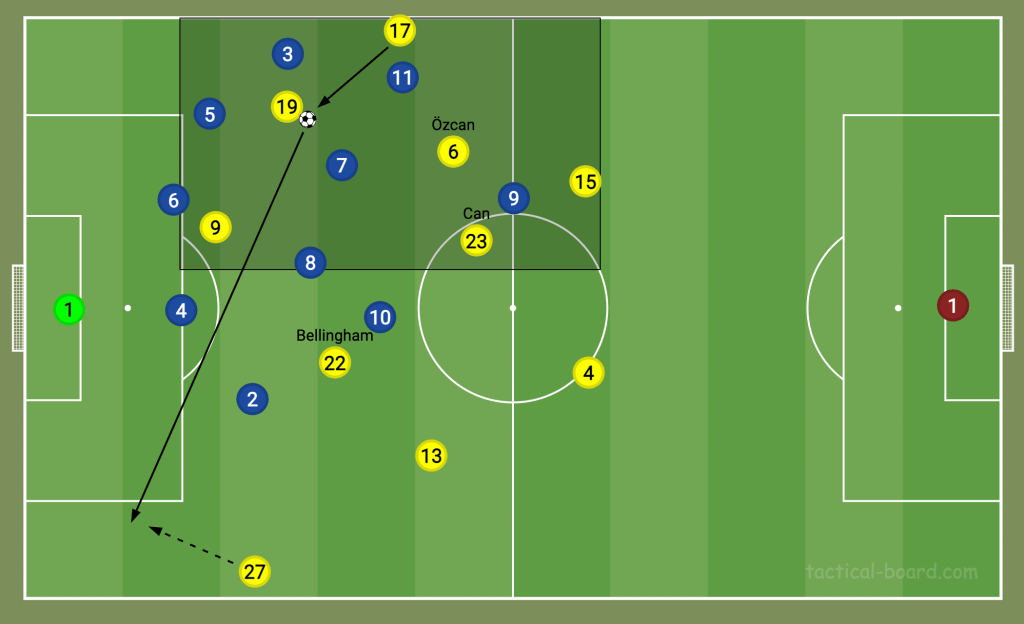
However, the change they made around late January saw Özcan replaced by the more attack-minded Julian Brandt. With Özcan, Can and Bellingham, they had a great balance but lacked a natural threat between the lines when Bellingham got on the ball. Brandt immediately solved a few of the issues they’d been having.
With Brandt roaming as a No.10 during build-up, teams couldn’t commit so many players to their press and instead had to watch for Brandt’s movements. Dortmund were able to play with two direct wingers, adding Donyell Malen, which gave them the ability to progress and switch to either side (not just from right to left as they had done when Brandt was on the right-wing). More importantly, however, Bellingham now had more freedom to drop in and assist Can during build-up, often arriving in the half-space to make a 3+2 shape.

Most notably, this midfield three has had real balance. Brandt takes up dangerous positions between the lines while Bellingham gets on the ball more. When Dortmund lose the ball, this is where the balance is more obvious. Without Özcan, Can no longer has to track back as he’s already in the holding midfield position, meaning defensive transitions are less risky. Bellingham can perform the shuttling role Özcan was so good at, and in Brandt, they now have an outlet well-positioned to receive a pass when they win the ball.

Much like Brighton, Dortmund like to create artificial transitional moments by baiting a press (often faking ball-carries with the full-backs), and Brandt’s positioning is key in linking defence to attack and left to right.
 Tactically Speaking