

Year after year, Pep Guardiola has been ripped apart for ‘overthinking’ in the Champions League latter stages, and never more so than when he played without a defensive midfielder in the 2021 final against Chelsea. What would his wild take be this time? Well, it was to play the already-out-of-position centre-back John Stones as a No.8 box-to-box midfielder. It’s safe to say this time, it worked, but why did he do it?
Inter’s famous 5-3-2 shape caused problems throughout the competition, and they had often tweaked it to make a 5-2-3 in the initial press. The majority of those who have studied Inter this year suspected they’d use this tactic against Man City’s 3+2 rest defence. Indeed they did.
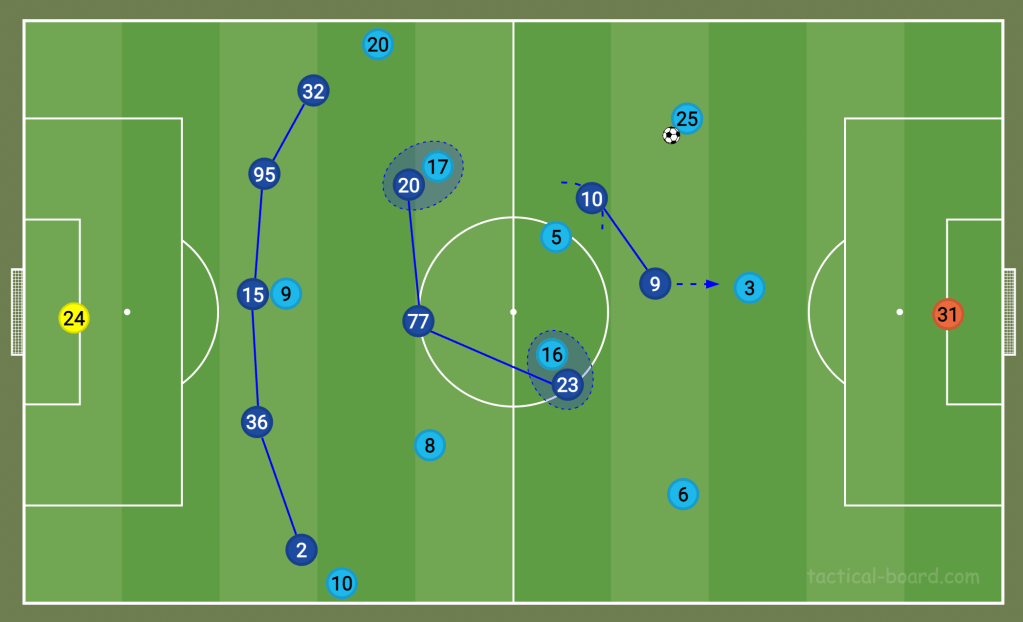
It would allow them to press high and man-for-man, stopping City’s build-up at source. However, a minor change by Guardiola from a 3-box-3 to (essentially) a 3-diamond-3 helped City in a few ways.
Most notably, it meant Inter could no longer press man-for-man. The distance between Rodri and Inter’s far-side winger was too long for them to sustainably mark him in periods of lateral circulation at the back for City. This meant he was unmarked, which — as the only pivot given Stones had advanced higher — was as crucial as anything for City on the night. In the diamond, Stones and İlkay Gündoğan could stretch Inter’s midfield, giving Kevin de Bruyne (and later Phil Foden) a central No.10 role, unmarked in behind Inter’s remaining two-man midfield.

Removing Stones from the first phase of build-up left just Rodri and the back-three. City then had three midfielders higher up. For this reason, Inter could no longer press high either. Their midfield was forced to worry about Stones, De Bruyne and Gündoğan, so despite losing a man from the first phase, City still had a four-v-three overload. Once they broke the first line of pressure, Rodri would find himself in the next phase, with Inter’s No.23 Nicolò Barella also returning to his regular midfield position. Therefore, despite Barella’s backtracking, City would again have a four-v-three overload.
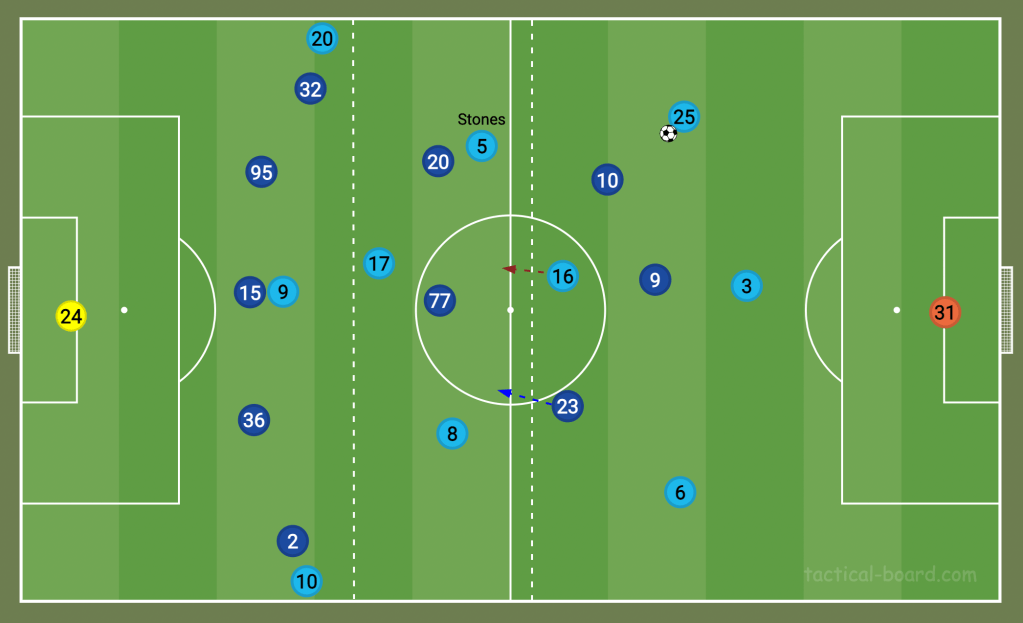
City’s usual shape this season has incorporated two wide No.10s. This has suited teams who defend with a back-five because they have centre-backs in the half-spaces to go man-to-man with City. By changing to a diamond, they rendered Inter’s back-five almost redundant. Inter had two centre-backs who couldn’t pick up any City players, which frustrated them and left them outnumbered further up the pitch.

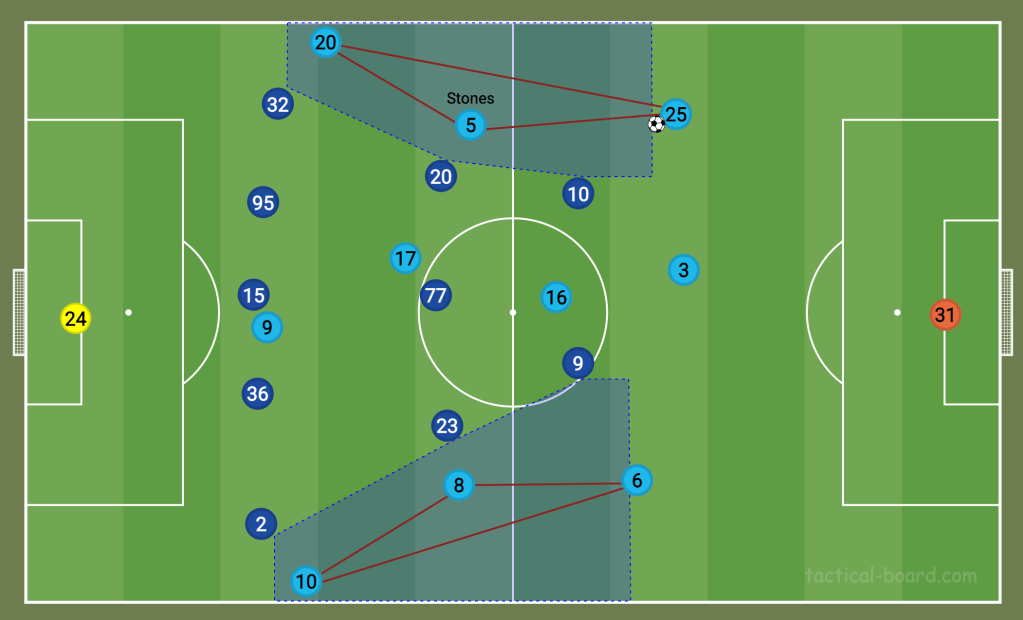
Finally, Stones and Gündoğan on the sides of the diamond gave City more natural width, with which they could expose the main weakness in Inter’s 5-3-2. Inter lacked width high up the pitch in their out-of-possession shape, so City found success out wide. With Stones playing as a No.8, he helped to create a lucrative wide triangle with the wide centre-back and the winger. If Inter struggled to get across to cover this flank, City could bypass their press this way. On those occasions when Inter shuffled over swiftly, City played a far switch to the other flank where Inter would have no players left.
 Tactically Speaking