

Denzel Dumfries. The answer to the question: What is the biggest issue faced by the current manager of the Dutch national team? Over the last four years, Dumfries has been one of the Netherlands’ most dangerous and consistent players, but one whose positional intricacies cause several complications elsewhere on the field.
Unmistakably a right-wing-back at club level, Dumfries is expected to provide almost all of the width in Inter’s 5-3-2 system. What does this mean? Well, despite traditionally coming from the ‘right-back’ breed as opposed to anything more advanced, more of his attention goes into stretching the play in attack than staying close to his fellow defenders. Indeed, he’s often Inter’s highest player when they have the ball.
The Netherlands have used him in the same way, trying to find a logical way of linking this marauding wing-back to a solid defensive line. A 5-3-2 got them through the World Cup, but it’s tending towards the ridiculous now with Dumfries so advanced that defensive transitions are simply too difficult to execute well.

The Netherlands need to relieve Dumfries of such defensive responsibility. A 4-4-2 would not only solve this issue but many more, too.
The primary fix here is the introduction of a back-four. The Netherlands have so many high-level defenders that they simply don’t need to play a back-three with wing-backs. We’ve seen a huge development in back-fours in the last six months, especially at Manchester City and Arsenal, where they’re now made up solely of robust one-v-one defenders. The uses of Dutchman Nathan Aké at left-back under Pep Guardiola and fellow international teammate Jurrien Timber at right-back for Arsenal this term can, and should, be utilised by Netherlands Ronald Koeman.

A by-product of this would be defenders now playing in the same roles they do for their clubs. This is a principle on which other national managers have been far more strict, and is one the Netherlands could benefit from adopting.
Looking at the system as a whole, it would suit the current needs of this Dutch team down to the ground due to their lack of one or two star players. The likes of Portugal and Argentina might be excused for building their team around a couple of players, but the Netherlands have no reason to do this. The beauty of a 4-4-2 has always been its emphasis on partnerships all over the pitch, as seen below.
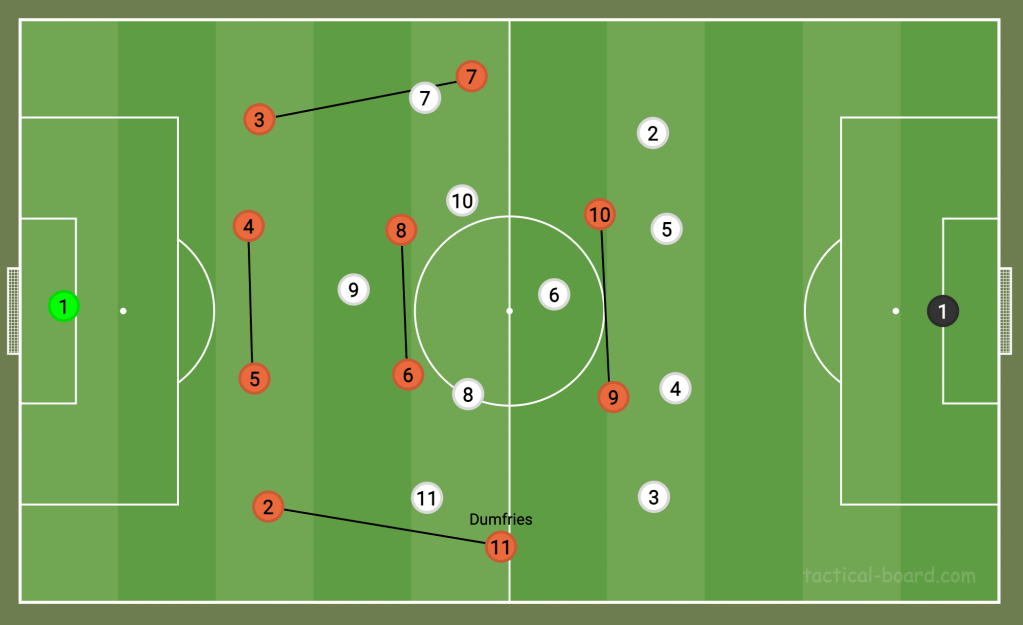
Take the No.9 issue, for instance. The Netherlands have no obvious striking option besides Wout Weghorst, so playing a system that incorporates a loan striker might not be a particularly wise idea. They’d be one-dimensional with Weghorst or forcing someone else into an unfamiliar position. For this reason, a strike partnership makes a lot of sense.
With only two central midfielders, they may not control possession against better sides, so they’d continue to enjoy playing the counter-attacking football we’ve come to associate with them over the last few years.
However, when they need to fill the midfield more, a centre-back pushing up or a forward dropping in would create the necessary overloads. Having players move into central zones from other areas is far preferable in the modern game to having them start in the middle and risk being marked out of the game from the beginning.
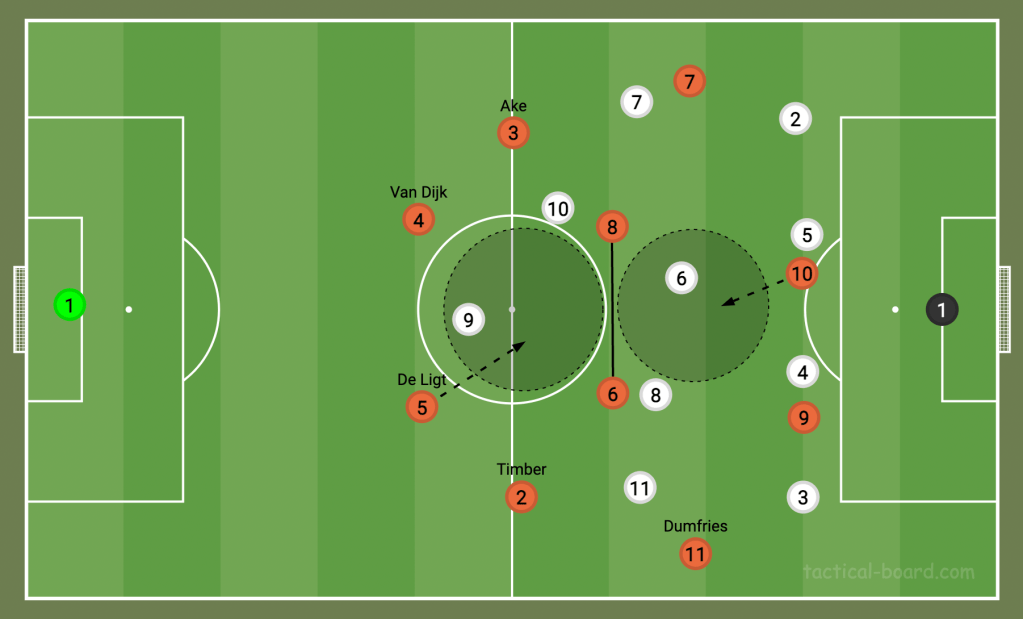
Any team has to work with what they’ve got, and the Netherlands have many elite defenders, along with fast and versatile attacking players. Solve the Denzel Dumfries issue, and they’ll be back among Europe’s very best outfits. A fluid 4-4-2 of partnerships, simple player instructions, and good coverage all over the pitch would give them the basis they need to play their best football.
 Tactically Speaking