
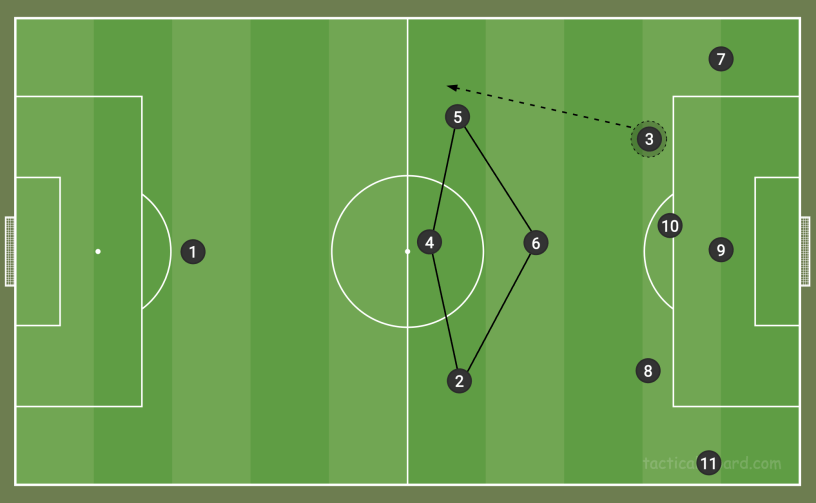
Germany have won just five of their last 22 matches. In that time, they’ve used all manner of formations and shapes in and out of possession, and they just keep getting more complicated. Why? Because Germany are extremely weak in the full-back department.
They’ve been trying to play asymmetrically, with one centre-back at right-back and a more traditional marauding left-back on the other side. This can work well, but each player’s required movements in defensive transition are so riddled with risk that they’ve become unbelievably vulnerable to opposition counter-attacks when they lose the ball.
A lack of quality at full-back has left them with this conundrum: Either they must use midfielders as wing-backs in a back-three system, or centre-backs as full-backs in a back-four system.

If the last two games have exposed anything, it’s that playing the likes of Kai Havertz and Julian Brandt as wing-backs will only ever be disastrous. It made their already poor transitions even poorer. Neither are established one-v-one defenders. So let’s take a back-four system — and this time make it symmetrical.
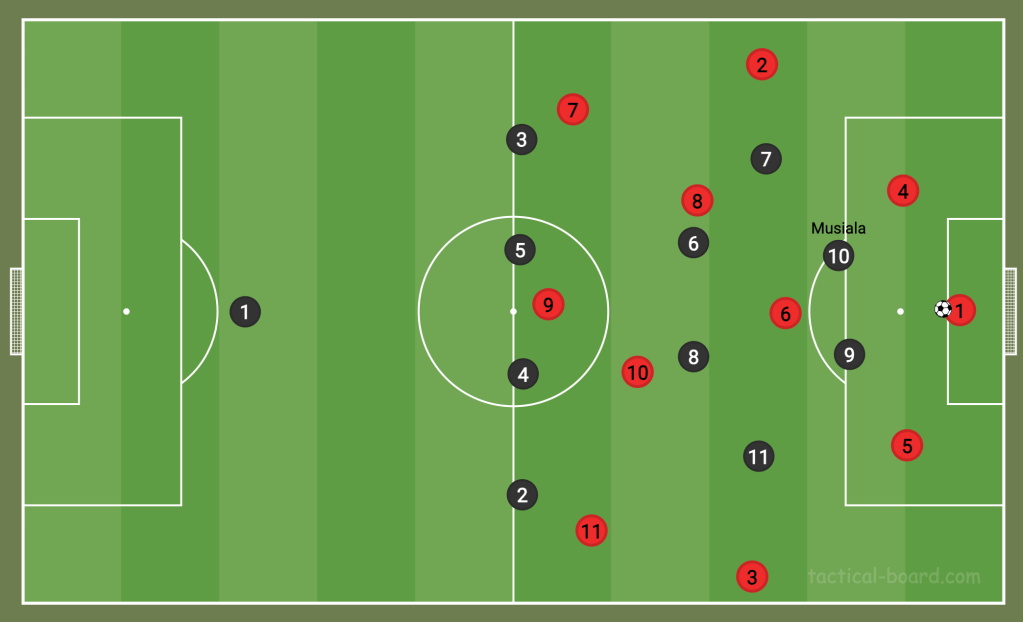
Further upfield, Germany’s main danger at Euro 2024 will likely come from the advanced role of Jamal Musiala. They’ll want him to remain central and free to roam wherever he pleases. If they’re going to control possession, could they play a diamond midfield, like we’re seeing from Real Madrid? No, purely because this requires the new auxiliary full-backs (probably still centre-back profiles) to bomb on up the pitch, a role they’ve likely never been exposed to. For that reason, Germany need to play with wingers who will provide the attacking width.

Playing a back-four, with wingers and Musiala free in midfield, is all possible within a 4-3-3. A 2-3-5 in attack would see all of this knit together nicely. They could protect against counter-attacks far better since their full-backs would be well positioned. Unlike those in a 3-box-3 shape, the wingers would be able to make frequent runs in behind the defence.

Off the ball, a 4-4-2 in the initial press would give Musiala the licence to go and chase the ball high up, with protection behind him.
 Tactically Speaking