Manchester City’s opening day victory against David Moyes’ West Ham side was won at full-back, and yet West Ham lost the game in midfield. Riddle that. Well, it’s not as complicated as it first sounds.
Pep Guardiola’s entire footballing philosophy centres around vacating and filling space, with a view to moving the opposition as opposed to the ball. Manchester City’s midfielders were rarely found in midfield yesterday, and their full-backs likewise took up central areas more often than wide areas.
Kyle Walker and João Cancelo have been pivotal cogs in City’s system for the past few years, with Kyle Walker helping to make a back-three at times, and Cancelo joining the single pivot in build-up. This has been Guardiola’s response to the tendency of English teams to press high up with two players. Using Walker as an extra centre-back helps to create an important overload in the first phase — helping to bypass the opposition’s press.
Yesterday, both full-backs performed the same function. For large parts of the game, Michail Antonio pressed high on his own, meaning Kyle Walker was better utilised in a three-man midfield with Cancelo and Rodri. This gave City two notable advantages.
Midfield Freedom:
In line with the ‘vacate and fill’ philosophy, Walker and Cancelo’s presence in midfield areas gave licence to Kevin De Bruyne and İlkay Gündoğan to roam high up the pitch through the half-spaces, causing difficulties around marking for West Ham. Either their defensive midfielders had to drop off to keep City’s two 8s at bay (leaving too much room in midfield), or their back-four would suffer City’s five-man overload.
Protection Against Counter-Attacks:
The positioning of Walker and Cancelo, in relation to the centre-backs and Rodri, provided excellent cover against both wide and central counter-attacks from West Ham. They formed a compact unit capable of shifting horizontally, and each player had a separate section of the pitch they were responsible for if a West Ham attack was to progress. Starting centrally with the option to cover wide areas proved more effective than vice versa, as it instantly eliminated the half-space as an attacking route for West ham, forcing them wide.
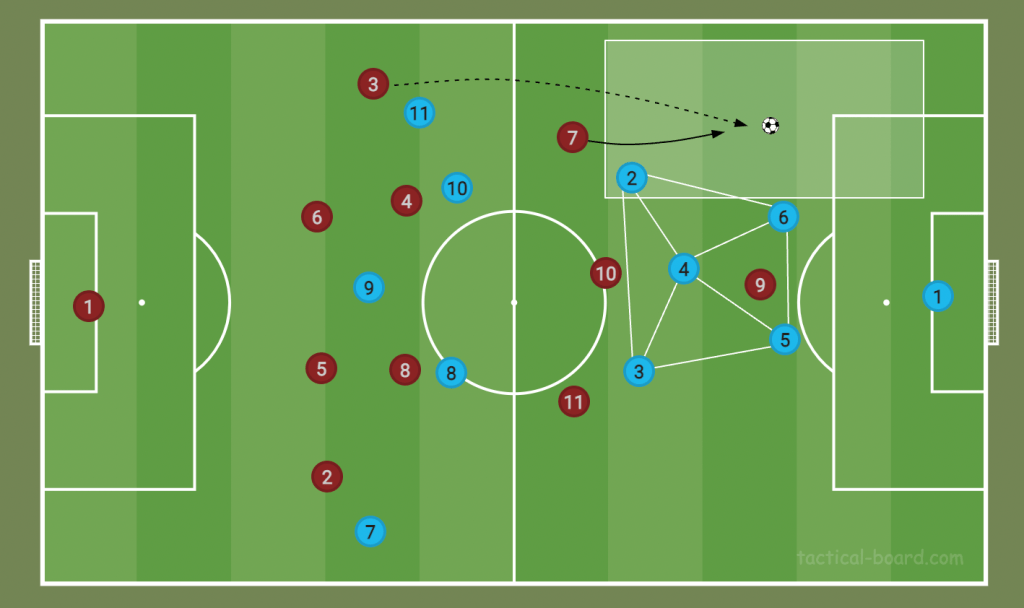
The first of these advantages led to Guardiola’s team taking the lead. Moyes made an adjustment to deal with it initially, whereby his midfielders would not press Walker and Cancelo, but would attempt to cut the passing lanes towards third man runners like De Bruyne and Gündoğan. This strategy was a largely efficient compromise between pressing and dropping deep, but eventually the intelligence of Gündoğan shone through. His third man run was spotted by Cancelo who was able to find him in between the lines, and from there, Haaland’s run in behind caught Ben Johnson and Kurt Zouma napping.
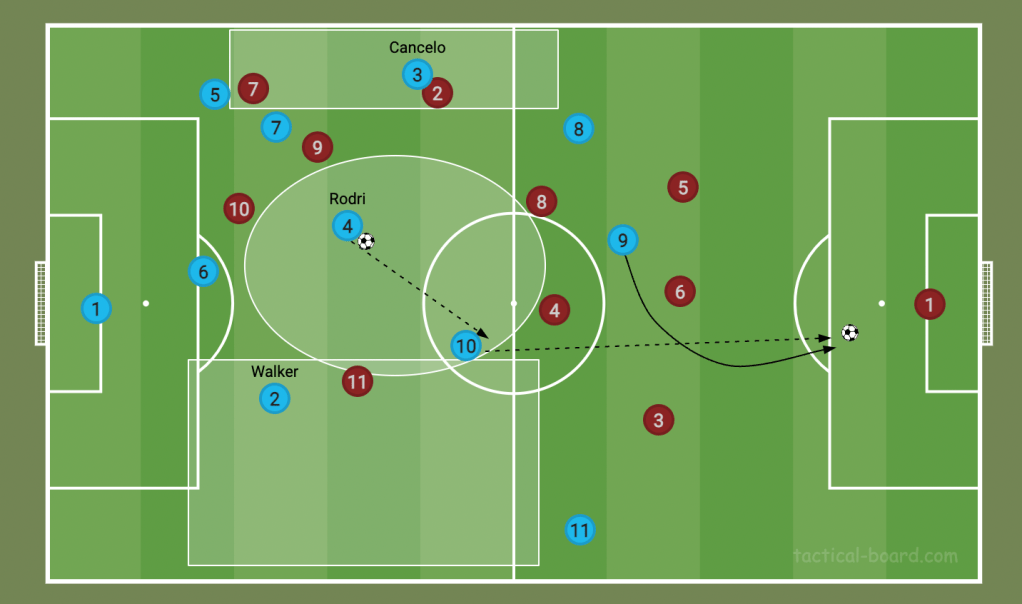
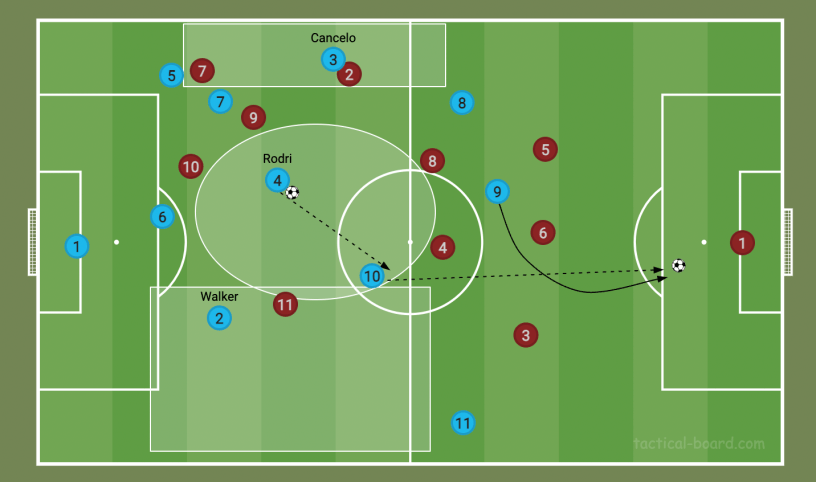
What is most impressive is that by the time West Ham had figured out the roles of Walker and Cancelo in City’s build-up, Guardiola had a second approach ready to implement. The full-backs began to spread in the first phase, more conventionally, as the game wore on. This forced those committed to West Ham’s press to spread and cover the pitch. However, vacating the central area left Rodri with acres of space to receive the ball, turn, and spray a pass out wide further up the pitch. Haaland bent his run, and De Bruyne found him with a pinpoint pass. This is how City managed to cut through West Ham’s midfield and defence for the second goal. Walker and Cancelo’s wide positioning attracted West Ham’s wingers, leaving Rodri with the entirety of the central zone to himself, as seen below.